Production Builders Are Creeping Into Custom Territory
Story at a Glance:
- Production builders are incorporating custom design elements like steeper roofs and mixed materials to differentiate homes and appeal to buyers.
- Investment in R&D is increasing among builders, focusing on innovative, cost-effective materials to improve homes without raising prices.
- Some production builders are pursuing infill lots and small sites that once belonged mostly to custom builders.
- Marketing strategies are evolving to emphasize how homes fit individual lifestyles, bridging the gap between production and custom homes.
A conference for production builders and developers turned out to have a lot to say that's relevant to custom building. I was in Austin recently for the New Home Trends Summit, hosted by the New Home Trends Institute, a division of John Burns Research and Consulting (JBREC), representing both Custom Builder and our sister publication Pro Builder.
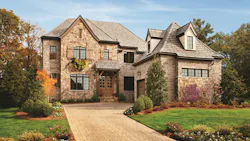
The nearest example was in a session on design differentiation with Brian Miller, senior principal at Danielian Associates, and Jessica Steeves, senior vice president at Builders Design. Miller said production builders in several markets are borrowing details from custom homes to break out of look-alike product. They're integrating steeper roof pitches, mixed exterior materials and broken rooflines that once marked an individually designed home. That's a compliment to custom builders, of course, but it also means a signature detail doesn't stay "signature" for long.
Design is Advancing on the Production Side
Miller described one production plan that was barely selling. After the builder added steeper roofs, mixed materials, box bays, and broken rooflines, it sold eight homes at a $30,000 premium in the first month. "People are just tired of the same," he said.
MORE: Builders and architects share what's working in 2026
Of course, a single month of sales can't prove a return on design, because there are other factors to consider too. But I think it shows how seriously some production builders are now taking design, even as they still have to think about the impact on cost and buildability across hundreds of homes.
Steeves described the same shift on the interior of homes, which she called a move "from designed for everyone to designed for someone." She also said buyers are looking for more authenticity as automation and AI advance into everyday life. "Craftsmanship is the new luxury," she said.
Some Production Builders Are Moving on From Generic Homes
The JBREC team opened their session with insight on buyers themselves, dividing them into four life stages. Young singles and couples make up about 10% of homeowners but 30% of annual home purchases, according to Eric Finnigan, vice president of demographics at JBREC.
Mikaela Arroyo, senior vice president and chief of staff there, said a home for these buyers has to feel like a step forward instead of whatever was left after the appealing features were cut. She cited JBREC research showing that Gen Z ranks the ability to personalize a home as the second most important reason to own one, after stability and security. That doesn't require endless options, she said. Builders can cut features these buyers won't miss to make room for ones they will, such as more storage, and offer a few bolder, curated finish packages, because buyers find a product less appealing when it looks "designed to offend nobody."
Two chief marketing officers, Stephanie McCarty of Taylor Morrison and Will Duderstadt of M/I Homes, had a similar take, saying that home building still sells square footage and bedroom counts even though buyers are really deciding based on how they want to live. Their advice was to bring marketing into product strategy earlier to help develop the right fit.
Summit speakers encouraged production builders to keep making their homes feel more tailored, including with more curated option packages. You can't assume clients will see the difference between semi-custom and custom, so you'll need to prove how your home would fit a client's life in ways production options just can't.
Production R&D Can Help Custom Builders, Too
More production builders are investing in research and development. Just over 35% of Top 200 builders now have an R&D function or a dedicated innovation team, up from about 25% in 2024, according to a Housing Innovation Alliance survey. Dennis Steigerwalt, the alliance's president, said the growth is strongest among the smaller builders on the list.
In a session Steigerwalt moderated, one of the country's largest home builders explained how it decides where to focus. Damien McBrien, director of strategic growth and innovation at D.R. Horton, said a new product has to improve the home without raising its price. "Adding the cost to a home doesn't help our buyers," he said.

MORE: Toll Brothers Told Investors It's Competing Against Custom For Land
Getting there took time and money. McBrien said the company runs a strategic partnership fund that invests in companies like Plantd, and Silvernail said Horton helped Plantd through certification.
Silvernail said Plantd also works with other companies and plans to launch insulated sheathing panels at the International Builders' Show in February.
When a large builder helps to bring a build-ready product like this into the market, it makes it easier and less risky for you to try them out on custom projects.
Production Builders Are Going After Custom Lots
Chris Hartley, Dallas-Fort Worth division president at K. Hovnanian, said his division spent several years competing with the largest builders on similar product and ended up discounting homes to sell them. "We are our own worst enemy," he said.
Now, the division is pursuing prime locations, infill sites, and large lots, including deals he said many public builders "will be afraid of." He described a 17-lot infill deal with $400,000 lots, where design guidelines require three-story homes under a 35-foot height limit, where no two houses can look alike.
Toll Brothers made a similar point to investors earlier this year, when CEO Karl Mistry said the company often competes for land against smaller custom builders, as we reported in June.
Still, Hartley's team is working from three floor plans on those 17 lots, which limits their ability to truly customize. There's only so much a plan can do to accommodate site constraints, proper orientation, mature trees on the lot, neighboring properties and a host of other variables. But the fact that they're moving onto lots like these should have all custom home builders taking note.
Related Reads

About the Author
Pauline Hammerbeck
Head of Content
Pauline Hammerbeck is head of content at Custom Builder, where she covers custom home building for builders, architects, and designers. She is also senior content strategist at Pro Builder, where she directs the brand's MVP Product Awards, and co-produces the Women in Residential Construction podcast, newsletter, and conference. Her background includes work in architecture, real estate, retail, and design.