Design Detail: A Secret Wine Room Beneath a San Francisco Remodel
Story at a Glance
- A custom pivoting bookcase door swings open to reveal a subterranean space six feet below grade.
- Extensive engineering and construction, including seismic retrofitting and waterproofing, ensured stability and climate control.
- Design elements such as RGB LED lighting, electric-blue marbleized flooring, and custom millwork create an immersive and theatrical atmosphere.
Welcome to Design Details, where we look at a standout project feature and explore what it took to make it special.
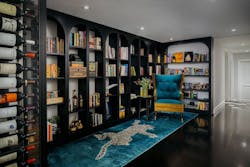
Beneath the riot of color, texture, and pattern in this San Francisco remodel, the most surprising space is a wine room six feet below grade, accessed through a bookcase that swings open in the hallway library.
Much like the home renovation itself, which started as a kitchen and bath update before expanding to the entire house, the wine room evolved from a more basic plan.
A Playful Idea
“The idea began with the clients’ extensive book collection. We needed a thoughtful, architectural way to house it all,” says Lizette Bruckstein, founder of Lizette Marie Interior Design in San Francisco. “As we began designing the custom bookcase, the clients loved the idea of incorporating a hidden door—something unexpected and delightful that felt true to their creative personalities.”
The bookcase already held everything from Shakespeare to Harry Potter, so a secret door embedded within it felt like a natural fit.
That playful feature developed into a broader idea to create a secret passageway leading to a subterranean wine room.
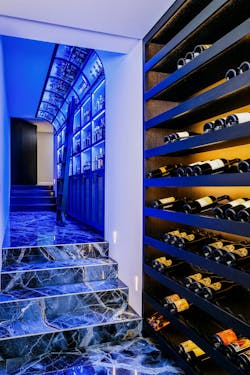
“It wasn’t just a functional choice; it was about creating a sense of discovery and playfulness that threads through the whole home,” says Bruckstein.
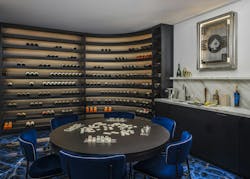
From the hallway library, the pivoting bookcase now leads down a secret stairwell that spirals slightly to build anticipation before the final destination is revealed: a subterranean wine lounge and game room with a bar and spirits display, electric-blue marbleized flooring, and dynamic RGB LED lighting.
It may feel like a theatrical flourish, but the underground space demanded serious engineering and coordination from the start.
The challenge was to dig out a subterranean concrete room and embed it with structural, seismic, and climate-control systems to protect both the space and the 100-year-old house above it.
"The construction budget for this portion of the build accounted for roughly 13% of the overall physical job costs," says James Biesecker of FORMA Construction, the San Francisco general contractor. "Many of the job costs were normal affiliations, but many items were far above average to ensure a successful build."
These costs included soil testing and extensive engineering to stabilize the ground, rerouting stormwater to the city sewer, pouring and spraying 240 yards of concrete, custom framing for walls and ceilings, multiple heating and cooling systems, and waterproofing the entire underground space, inside and out.
Making it Work
The project was a technical feat.
“The structure needed to be completely below the existing patio and yard off the main level of a historical home," Biesecker explains. "There were no allowances for additional permittable space above grade for this property."
Because of its San Francisco location, there were also many restrictions on seismic retrofitting that impacted the new build. “[The underground wine room] compromised the existing structural integrity of the home and required advanced soil grouting and seismic underpinning to nearly 30 feet below the structure," Biesecker says.
Climate Control

Moisture was also a key concern, as always with any underground space, but more notably when building in a rain-heavy region like this.
"We used multiple systems beneath, around, and within this new space to control and alleviate all concerns," Biesecker says.
The approach was comprehensive, with a thick layer of drain rock and perforated drainpipes under the entire footprint and around the perimeter; exterior drainage barriers to direct water away from the structure; and multiple waterproofing layers applied both inside and around the exterior envelope.
Moisture and overall room temperature are regulated by a remote mini-split, while a secondary cooling system helps keep the extensive wine collection at the proper temperature in a glass-enclosed separate space.
The Magic Door
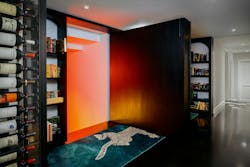
Upstairs, the bookcase door presented unique challenges, requiring collaboration with a millwork subcontractor to create a design that would be lightweight but still able to support the heft of a large book collection on a single pivot hinge that swings out over an almost seven-foot span.
"This required the use of aluminum hexagonal honeycomb framing materials embedded in layers of wood veneer,” says Biesecker, “so that the overall entry door could rotate more than 90 degrees, from closed to open, without deflection."
That system required early coordination. “It was monolithically poured into the new three-foot by six-foot deep stepped grade beam,” says Biesecker. “This included routing of control and power supply conduits, pit drainage connections, and the exact placement of the hydraulic pivoting drive."
One of the final challenges was how to prevent any of the colorful lighting from the underground space from bleeding out into the main house (this is a secret room, after all).
"We accomplished this using weighted blackout strips that slide up into the door as it rotates, so they don't drag on the carpet,” says Biesecker, “as well as multiple layers of overlapping mesh weatherproofing on the vertical access points of all the operable cabinets."
The Atmosphere
Once the technical pieces were in place, they worked seamlessly as a canvas for the desired immersive experience to come alive.
"The design relies heavily on atmosphere, texture, and color," says Bruckstein.
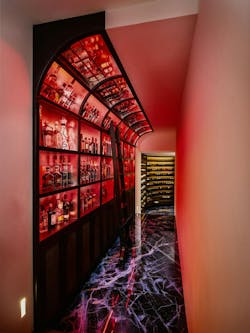
The electric-blue marbleized flooring was “chosen for its bold, immersive quality” and to distinguish the space from the rest of the home, while RGB LED lighting creates “a moody, transformable environment.”
Throughout the space, custom millwork shapes the curved stairwell descent (dubbed the "Spirits Tunnel") and the built-in arched details in walls and ceilings. FitzFelt acoustic felt absorbs sound, Buster + Punch hardware provides industrial character, and an Artemide Alphabet of Light fixture marks the game table. A climate-controlled, glass-enclosed wine room houses the collection.
Lessons for the Trade
Bringing all the disparate elements together required careful coordination between the design and construction teams.
Biesecker says others working on similar projects should take note to “integrate redundant systems for moisture intrusion and vapor mitigation around the building envelope,” and to “get guarantees from the architect and the local planning department regarding all site development work that could trigger the enforcement of more stringent guidelines.”
He also suggests providing 3D renderings of all impacted spaces, interior and exterior, to help everyone visualize the process.
It’s a sentiment echoed by Bruckstein, who says, "hidden spaces require thoughtful choreography.”
“You're designing not just a room, but an experience,” she says, “and that means paying attention to both the reveal and the destination."
A hidden room only works if it feels thematically connected to the home and the client. The secret door, the millwork, and the framing aren’t add-ons. They need to be planned from the beginning. “Integrate the architecture early,” Bruckstein advises.
All in all, she says, “don't be afraid of bold, unexpected choices. A hidden room is an invitation to be creative." CB
Project Details
Interior Design: Lizette Marie Interior Design
Contractor: FORMA Constructoin
Architect: Geddes Ulinskas Architects
Millwork: Mueller Nicholls, Inc. (now MN Builders)
Lighting Consultant: Spectrum Systems, Inc.
Photography: Christopher Stark
Acoustic Wall Treatment: FilzFelt
Cabinet Hardware: Buster + Punch
Lighting: Artemide, Alphabet of Light
About the Author
Pauline Hammerbeck
Head of Content
Pauline Hammerbeck is head of content at Custom Builder, where she covers custom home building for builders, architects, and designers. She is also senior content strategist at Pro Builder, where she directs the brand's MVP Product Awards, and co-produces the Women in Residential Construction podcast, newsletter, and conference. Her background includes work in architecture, real estate, retail, and design.