Under Pressure: 6 Homes Navigating Tight Lot Challenges
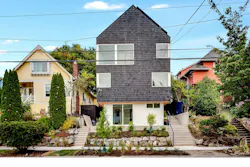
Narrow lots and neighboring walls push decisions about light, privacy, and scale early in the design process. Here, we look at six projects that show how different firms handled such constraints: tucking behind existing homes, extending historic structures, stacking vertically to capture daylight, or just more purposefully orienting toward the urban view, rather than away from it.
Building a House on a Lot Meant for an ADU
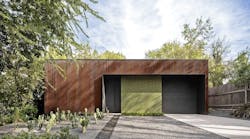 Stealth House front elevation
This home, known as 'Stealth House,' sits on a gravel alley in Austin and is tucked behind more traditionally built homes on a 3,500-square-foot lot originally intended for an ADU.
When Scott Specht of Specht Novak Architects found it, he thought it was a site close enough to downtown to justify a full home. Built with Austin-based Smock Build, the 1,300-square-foot house is discreet from the street; but, once inside, there are large windows and courtyard views that open it up considerably. [See the rest of the project→]
A Two-Story Addition Opens Up a Cramped, Historic Home
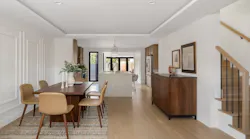 Alexandria row home dining room
The homeowners of a historic row home in Old Town Alexandria, Va., fell in love with the narrow property's walkable location, but, built in 1948, the home felt cramped, compartmentalized, and lacked a floor plan suitable for modern living. They ultimately turned to McLean, Va.-based Winn Design + Build to help reconfigure the disjointed layout and bring it into the present day.
Serving as both architect and contractor, Winn Design + Build opened the floor plan and brought in lighter finishes to help brighten and update the space. A new two-story rear addition was also added, expanding the narrow structure from just 1,814 square feet to 2,832 square feet. [Go deeper on this project→]
Four Units With Inverted Floor Plans on Two Adjacent Lots

In a densely populated Seattle neighborhood, Hybrid Architecture developed two adjacent infill sites: The Lookout, a single-family home elevated above three parking spaces, and Shake Shacks, three cedar shake-clad townhomes.
Hybrid designed the projects with an inverted floor plan to maximize air and light. “Elements are stacked vertically to take advantage of the smaller footprint of tight urban sites,” says the firm's development manager Alex Herbig. [Read the full project→]
Two Homes, Each 50 Feet Wide, One Shared Lot
 Prescott and Maximus exteriors | Narrow lot | Visbeen Architects
On a small infill lot in East Grand Rapids, Mich., two homes exemplify how custom homes can still achieve design quality while minding narrow lot lines.
Designed by Grand Rapids, Mich.-based architecture firm Visbeen Architects, the homes share a lot, and are no wider than 50 feet apiece. They show how contemporary and traditional designs can effectively be paired, while also fitting in with neighboring homes. [Read the full case study→]
Chicago Infill Turns Views Toward the Train Tracks, Not Away
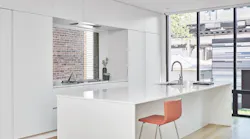
This three-story rowhouse sits in a dense Chicago neighborhood in which the back wall of the house stands 75 feet from one of the city’s famed elevated train tracks.
But rather than ask the architects to block train views and noise, the clients wanted to embrace their urban setting by highlighting the tracks. This led to a nearly transparent back wall that lets natural light pour into the narrow home. [See the whole project→]
Tearing Down and Rebuilding to Downsize Right
 Exterior of Rad Trad home
Traditional design has been gaining traction, but that doesn't necessarily mean giving up on the functionality or openness of a modern home. This balance was Best Practice Architecture’s philosophy when designing a custom home for a retired couple in Seattle’s Madison Park neighborhood.
According to Sarah Smith, principal at the Seattle-based firm, the couple purchased a 1940s home with the goal of downsizing, but the space wasn’t exactly suited for modern living.
But seeking the help of Best Practice as well as Seattle builder Summit Development, the homeowners were able to tear down the former home and reimagine the small lot with a 1,315-square-foot traditional home designed to better function in modern day. [See how the new home lives now→]
In Case You Missed It...
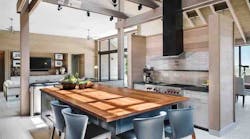
 Seattle floating home
 Meadow House in Alta, Wyo.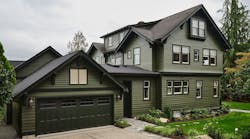
About the Author
Pauline Hammerbeck
Head of Content
Pauline Hammerbeck is head of content at Custom Builder, where she covers custom home building for builders, architects, and designers. She is also senior content strategist at Pro Builder, where she directs the brand's MVP Product Awards, and co-produces the Women in Residential Construction podcast, newsletter, and conference. Her background includes work in architecture, real estate, retail, and design.