The Best Design Decision on This House Was Leaving the Site Alone
Story a glance:
- The design of this home responds to a 15-foot grade drop that influences interior levels and outdoor terraces.
- Neighboring structures and mature trees shaped the home's massing, ensuring it fits into the neighborhood scale.
- Material choices like Texas brick and wood create a warm, regional aesthetic that balances the modern design.
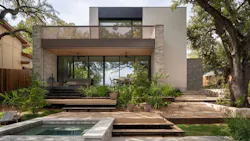
The lot already had a house on it when the clients found it: an older structure in poor condition that didn't survive long after they closed.
What remained was 68 by 130 feet of sloped urban land near downtown Austin. By Chicago or New York City standards, that's an ordinary suburban lot. But in Austin, it comes up a bit short.
“When you’re used to sprawling multi-acre properties, it’s a pretty constrained lot,” says Jakeb Novak of Specht Novak Architects, the Austin-based firm that worked on the project.
The clients, a young family that had relocated from New York, had found the property before engaging the architect, drawn to its proximity to the 351-acre Zilker Metropolitan Park.
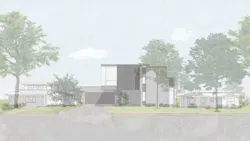
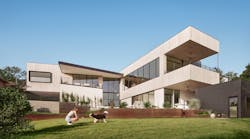
The site itself, however, presented a specific set of challenges for Novak: a 15-foot grade drop toward the rear, a stand of heritage live oaks along the back property line, a single-story bungalow on one side, and a tall mature tree on the other.
"We do a site analysis first and list out the constraints," he says. "And then we look at how those factors can start to influence the design, as a component that influences the form of the house."
More: This Compact Austin Home Prioritizes Functionality
The clients made that approach easier, Novak says. "It wasn't like working on a development project where we're trying to maximize every square foot and just build out the lot," he says. "It was really balanced to the family's needs, and there is a certain efficiency behind that."
Letting the Grade Lead
The 15-foot drop at the rear of the lot was the first thing considered. Flattening would have required significant fill and pad work, so they left it intact.
"We typically try to work with the grade as opposed to working against it," Novak says.
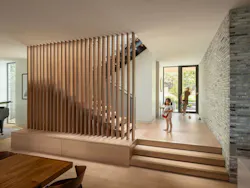
That grade, which otherwise might have been viewed as a flaw, was ultimately what dictated the interior floor plan and the landscape. The result is a home that keeps in step with the sloping terrain. From the entry foyer, stairs descend into the main living area. Once outside, a sequence of terraces drops toward a pool that sits at the lowest point of the site.
Massing that Mixes with Neighbors
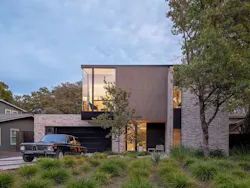
Next, it came down to considering the two neighboring lots: a single-story bungalow on one side of the property, and a towering mature tree on the other. That asymmetry shaped how the front façade was designed, Novak says.
“It made sense to push the height of the house back behind the taller tree on one side, to help fit it into the neighborhood scale," he says.
More: Luxury Housing Markets to Watch: Park City, Austin, Charleston
The other side required bringing the home down to scale to match the adjacent bungalow.
But the challenge in doing that was the garage. Because the lot was tight, the garage had to face the street (never a favorite for an architect), so Novak sought to absorb the garage into the design.
“The challenge was how to make it read as part of the composition, this modulated massing on the façade,” he says, "including making the door look more like a fixed panel as opposed to a garage door."
What the Trees Provided
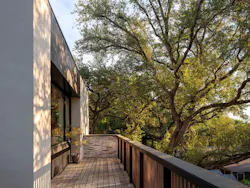
The trees at the rear of the lot introduced a separate set of challenges, but also unexpected benefits.
Austin's heritage tree ordinance determines construction setbacks based on trunk diameter, requiring builders and architects to hold work outside the critical root zone of protected specimens.
On this lot, that regulation shaped the rear landscape layout: hardscape positioned away from the root zones, soft landscaping kept around the trees.
"You have to be very careful about how close you can impede into the critical root zone of the trees," Novak said. "So, if a tree is a certain size, you have a certain distance that you have to hold the construction away from the tree to preserve the health of the tree."
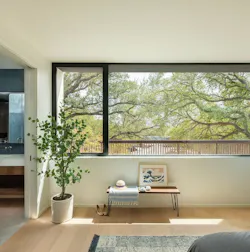
The line of live oaks along the rear property line also resolved a problem the design would otherwise have had to solve directly. The main living area opens to the rear yard through a full glass wall, the kind of feature that typically then requires a privacy solution in a dense urban neighborhood like Zilker, where this home is located.
"In addition to the shading they provide, those trees provide a nice privacy buffer," Novak said. "In an urban context like this, it’s difficult to provide nice open glassy areas in a way that you will not be staring at your neighbors."
Modern Design, Material Warmth
That glass wall that the trees made possible was part of a larger question Novak had been working through: how to keep a modern design from feeling out of place in what is ultimately a traditional neighborhood.
Several material choices were considered, including a few iterations looking at natural stones, different brick types, and color variations, before they found the right fit that also resonated with the client.
On this project, that process pointed toward brick and wood. Both are warm and offer texture against the clean lines of the structure. "We've tied in old Texas brick and wood, two warm materials to help balance our modern aesthetic with this existing neighborhood, so it just felt more integrated," Novak says.
The alternative, a more commonly used stucco, would have pushed it toward what he describes as "white stucco box developer homes."
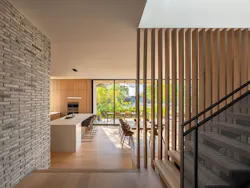
Both of the chosen materials carry through to the interiors, with brick reappearing on a wall between the main stairs and the living area; wood batten from the exterior facade returns as a screen of sorts in the same location.
The connection between exterior and interior materials was strategic. "Bringing those materials to the interior offers consistency and flow and helps extend the indoors to the outdoors," Novak says, particularly where the glass wall and brick meet in the living area.
A skylight over the stairs helps keep things airy. “It's important when you have a deeper floor plate like this to introduce a skylight, which brings in natural light to the core of the house," he says.
Asked what another architect or builder could extract from this project for their own infill work, Novak keeps it direct: "Look for a way to use some of the restrictive qualities of the lot to help influence the design in a positive way," he says.
On this project, none of it had to be undone. It was just a matter of reading the site first.
Project Details:
Location: Austin, Texas
Size: 3,300 square feet
Architecture: Specht Novak
Structural Engineering: Fort Structures
Landscape Architecture: Open Envelope Studio
Photography: Leonid Furmansky
Related Reads:

About the Author
Pauline Hammerbeck
Head of Content
Pauline Hammerbeck is head of content at Custom Builder, where she covers custom home building for builders, architects, and designers. She is also senior content strategist at Pro Builder, where she directs the brand's MVP Product Awards, and co-produces the Women in Residential Construction podcast, newsletter, and conference. Her background includes work in architecture, real estate, retail, and design.