Custom Homes Shouldn't Be Lit Like a Warehouse. Many Are.
Story at a Glance
- Lighting consultant and educator Kelly Inglis highlights the significance of layered lighting in residential spaces.
- She advocates for recessed lighting that mimics the natural shape and function of the human eye, avoiding flat, intrusive fixtures.
- Proper planning in key areas like kitchens and architectural features can reduce fixture count and increase overall lighting quality.
- The focus is on creating lighting environments that feel natural, purposeful, and enhance the architectural details of a home.
Kelly Inglis has spent more than 20 years in residential lighting as a showroom buyer, manufacturer's rep, and national speaker for the National Kitchen and Bath Association. Her focus is architectural lighting: the layer most project teams overlook and most clients never know to ask for.
We spoke with Inglis about what consistently goes wrong in custom projects, why it matters, and what it takes to get lighting right.
Custom Builder: You say once a client experiences good lighting, they’ll never go without. What's in the way of that?

Kelly Inglis: When you're building a home, you're inundated with so many decisions. And if no one's addressing the importance of lighting ... you don't know what you don't know.
You’re functioning and living with poor lighting because that’s what you have there, and you didn’t know otherwise.
It's the same as getting a new bed and you go, "Oh my gosh, I didn't know I needed this so badly."
CB: You talk about how modern homes are often lit like a "bright white box." What are you seeing?
Inglis: What I'm finding in new homes and in high-end homes is … I call it Costco. There's no feeling. It's just a bright lit box—white walls, white ceilings—and now we've just filled the ceiling with a grid of lights because we know it works, and it's safe. [But] Costco wants you to come in and get out. If we light our homes like Costco, we don't rest.
A white box versus drama, color, and shadows feels different. We look at sunsets for relaxation, and sunrises for energy. When we implement some of those elements in our homes, it’s beautiful. When somebody’s had the sensation of "noise" (I call it noise) reduced to something more comfortable, they wonder how they lived without.
CB: You often compare the layers of light to music. What happens when a home only has one layer?
Inglis: I started a new class where I aligned lighting environments to music. Imagine going into your home every day and the music's heavy, upbeat all the time. You wake up, that's the music. You start your day, that's the music. You start going to bed, that's the music. If your lighting moved to music [in that house], you would only have one layer.
So, if you can add softer music, the lighting would then shift, the color may shift, the environment shifts. Lighting is much like music where you feel it.
Q: You advocate for recessed lighting that "disappears" over the common flat LED discs. Why?
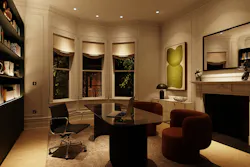
Inglis: My passion is lighting that you can’t see. You want the architectural lighting in your home to disappear. So, the second we cut a hole in the ceiling, the purpose is to regress it, not let it sit flush.
We also want it to function like our eyeballs do. Our eyeballs do not sit flush—if our eyes sat flush, we would be blind. From our eyebrows to the center of our eyes is 45 degrees, and a good functioning downlight from the center to the edge is 45 degrees. So, the more it looks like our eyeball, the better it will function and the more relaxation we feel within our space. When we look at that flat disc, it doesn't deliver because it's flat. The optics, the qualities that make it functional, have been removed.
So, if you take one grid section from a plan... and you have 12 flush discs, that's like being outside staring at the sun 12 times. Versus coming into a space where they’re regressed, and you have 12. Now you’re going in and seeing the space, and the elements, and the details, and the finishes. There are so many issues with this product because of the price point. It’s essentially the Temu of lighting design.
CB: Is there a project where the traditional approach was underway, and you had to advocate for change?
Inglis: [A builder] brought me in because his focus was lighting the beautiful beams on a barrel ceiling. I walked onsite, and the contractors were on scaffolding literally installing light fixtures. They had about 12 to 16 six-inch downlights installed in the soffit with screw-in LED light bulbs.
It was a giant 20-foot barrel ceiling and I said, “You're going to have to call that scaffolding back in two to three years to replace those fixtures. I also think there's too many fixtures. The light bulb just doesn't have the power. You need a dedicated light engine. All you're going to see is 16 holes in the ceiling beside your beams. So why not eliminate the issue, do beautiful performance fixtures, and your beams will be in view, not the light fixtures.”
We did a calculation based on the ceiling height and the space. We reduced the aperture to four-inch, the fixture count went to six, and we increased the light output 10 times.
Everyone pushed back because now we’d delayed the job. They had to remove all those lights, wait for the new ones. It was a big issue. But we were also able to guarantee more longevity, so he wouldn’t have to get on scaffolding to do any maintenance to those light fixtures. A lot of them are accessible from below, so he’s not interfering with the ceiling. And that’s when everyone went, ‘Whoa!’. That brought the team on board.
CB: Where should a builder or architect start when trying to create a better lighting plan?
Inglis: I like to start in the kitchen, in the open concept spaces. We are going to eliminate the grid, and start plotting lights in the task areas like the kitchen island, perhaps the dining or a nook area. Then I'm going to start lighting vertical surfaces that are important, like the cabinetry. A good lighting design is going to light your verticals and your task [areas]. I see downlighting put in the aisle of the kitchen all the time, so all the most usable light is on the floor.
Then, we start to move on to fireplaces, any architectural elements that have any substance. Artwork is another great place to go. Now I have 12 lights throughout the entire open concept that are lighting with purpose and not just in a grid.
We can often reduce the number of fixtures because there's thought behind it, which therefore adds more dollars to spend on better-quality fixtures.
Kelly Inglis is a lighting consultant with the British Columbia-based Mac's II Agencies and an NKBA CEU-accredited educator. She represents nearly 100 manufacturers across the residential and commercial market and speaks at NKBA chapters throughout North America.