What it Takes to Build for Global Clients
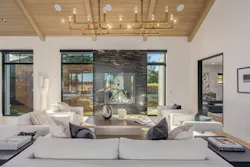
International buyers spent $56 billion on U.S. residential property between April 2024 and March 2025, according to the National Association of Realtors' most recent report on foreign transactions. Nearly one in five paid more than $1 million, and 47% closed in cash.
That cohort, concentrated in South Florida, Northern California, Los Angeles, Texas, and other gateway markets, overlaps heavily with the custom home client base, and its expectations are reshaping how builders and architects operate.
Buyers from Latin America, Asia, and Europe carry cultural frameworks that shape everything from entry sequences to material sourcing, and builders and designers are adjusting processes and specifications to keep up.
That shift runs alongside a second. International studios are entering the U.S. market, often at the invitation of those same clients, while well-traveled American buyers who've spent time abroad return with design references and requirements that sit outside the typical domestic custom build.
Cultural expectations drive early design decisions
Concepto Taller de Arquitectura, an architecture, design, and real estate development firm working across Mexico, Spain, and now the U.S., has a residential project underway in Miami.
Co-founder Alberto Dana draws a line between how domestic and global clients approach a build. American clients typically prioritize lifestyle and the home as an investment, he says, while global clients approach a home as a cultural expression, a reflection of identity, memory, and the way they occupy space.
"Latin American clients usually bring a deeper emotional connection to materiality, scale and texture, while Europeans tend to value restraint, proportion, and balance more than size," Dana says. "In Asian-influenced approaches, there's a deeper sensitivity to calm and ritual."
Miami has become a global magnet in recent years, says Michael Martinez, an agent with ONE Sotheby's International Realty. His international clients tend to build rather than settle for a property that doesn't match their vision.
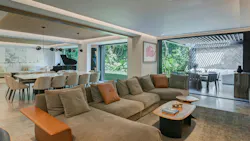
Separately, many clients in Florida also come to Concepto Taller looking for a perspective that diverges from the norms of the local Florida market.
Indoor-outdoor living functions as a foundational structure rather than an added amenity, with gardens, courtyards, and space configurations that builders must translate into local construction systems and code. Casa La Palma, the firm's project in Cuajimalpa on the western edge of Mexico City, follows those same principles.
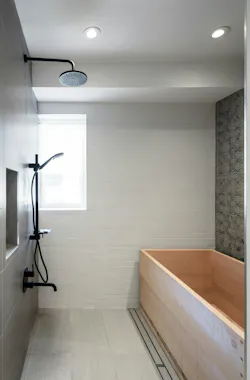
Cultural practice often determines the plan. Toronto-based architectural firm Picnic Design recently completed a significant renovation for a family whose program began with the traditional Japanese bath. The design drew from ritual bathing without literal reproduction, anchored by a custom hinoki wood ofuro (a deep-soak Japanese wooden tub) from Bartok Design and an adjacent tatami room.
Materials like those carry lead times that can exceed 16 weeks, which forces builders to sequence construction around arrivals rather than the other way around.
Other features now appearing in international-client briefs include second kitchens for spice-heavy cuisines, puja rooms, qibla-oriented prayer rooms, genkans, majlis seating rooms, and fully separate multi-generational suites within a single home.
Builders adapt process, not just aesthetics
Those client requests pull through to material specification and construction methods. International buyers routinely bring non-domestic material preferences and indoor-outdoor frameworks that builders must reconcile with local systems, which can mean re-engineering drainage, glazing, and roof assemblies before a foundation is poured.
"International buyers approach custom builds with a very clear vision," says Juan Pablo Chacon, an agent at Douglas Elliman. "They tend to be more design-driven and detail-oriented from day one. They often come in with references, architects, or at least a strong point of view. Compared to domestic buyers, there's usually more emphasis on privacy, security, and how the home flows for both family and staff."
Proper entry sequences, double-height volumes, spa-grade bathrooms, and dedicated live-in staff quarters recur in the briefs. Material palettes run toward natural stone, specialty finishes, and imports that rarely surface in standard custom spec sheets.
The requests compound on one another: a double-height entry asks different questions of the HVAC layout, which asks different questions of the roofline, which asks different questions of the stone supplier waiting on a container at port.
They tend to be more design-driven and detail-oriented from day one. They often come in with references, architects, or at least a strong point of view.
- Agent Juan Pablo Chacon, Douglas Elliman
Bevan and Associates, based in Sonoma, Calif., designs custom homes primarily for California clients but has worked internationally. At 601 Napa Road, a four-acre ground-up build completed in 2024, the project addresses what many international clients prioritize: how light, views, and circulation link spaces to one another, and the land around them.
Putting it into practice
Builders working with international studios or clients face friction around differing code standards, measurement conventions, and detail expectations that don't translate cleanly. Sourcing stretches, too, when a brief calls for a specific Turkish terracotta or a limestone quarried in one particular region, and the schedule has to absorb the wait without stalling trades already on site.
"It's not about changing the aesthetic of a project, it's about rethinking the process behind it," Dana says. "Serving a globally-minded client requires stronger sourcing strategies and a clear understanding of what can realistically be achieved locally versus what needs to be brought in. That transparency is essential."
The practical shift happens at the intake stage. Builders and architects now work through a more demanding set of early questions:
- how clients live
- how they entertain
- how privacy is drawn between family and staff
- which cultural rituals or heritage elements are non-negotiable.
Those answers shape decisions more meaningfully than any mood board, and they decide whether a project runs clean through closeout or unravels somewhere around framing.
You Might Also Like...

 The Quincho from outside
About the Author
Emma Reynolds
Emma Reynolds is a New York City-based freelance luxury writer who covers travel, real estate, design, architecture, and more. Her works has appeared in Forbes, Robb Report, Elite Traveler, Business Insider, Mansion Global, and many more.