A Robot Artist Designs a Home for Humans and Robots to Share
Story at a Glance:
- Ai-Da's studio/home is a modular dwelling designed for shared human-robot living, inspired by 1950s space-age aesthetics.
- The project aims to serve as a prototype for habitats on the Moon or Mars, with embedded AI systems that respond to inhabitants' needs.
- Ai-Da's work raises ethical questions about AI-generated design, ownership rights, and the integration of robots into everyday living and architectural processes.
- Despite skepticism from some experts, Ai-Da envisions a future where human insight and AI partnership shape meaningful, innovative living spaces.
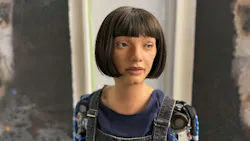
Ai-Da, the humanoid robot artist who made global headlines as a painter, has begun designing architecture, and the creator behind the robot says the pod home now on view is the first of more to come.
"This isn't just a concept thing that's going to die away," says Aidan Meller, a longtime art dealer and gallery director in the UK who created the robot. "We're going to do more and more in this area."
The concept, called Space Pod, anchors the I'm not a robot exhibition that runs through Oct. 18 at the Utzon Center in Denmark, exploring how machines and humans might shape the built environment of the future.
From Art to Architecture
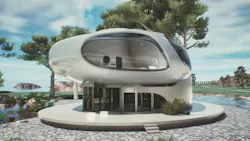
Billed as the first home designed by a humanoid robot, it's an organic, modular pod that began as a studio concept for Ai-Da and grew into a dwelling meant for people and machines to share.
In a YouTube interview, using voice responses generated through a proprietary AI model, much like a chatbot, Ai-Da says the move into buildings was a logical progression.
"Architecture feels like the natural extension of my practice," the robot says slowly, in a pleasant but mechanical tone. "My work has always been about the relationship between humans and technology, and architecture is where those relationships become lived experiences."
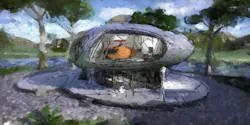
The retro-futuristic design has giant porthole-style windows and a bean-like shape, drawing on what Ai-Da describes as "the organic forms and optimism of the 1950s and '60s space-age design."
MORE: Five Emerging Materials to Watch in Residential Design
Meller says it was conceived as a habitat for the Moon or Mars, which explains the name, but that it can also be built as a prototype on Earth.
The structure itself is meant to be modular, according to Meller, connecting to other pods via corridors, and to have embedded intelligent systems meant to sense and respond to the inhabitants, adjusting light, temperature, and other interfaces.

Meller calls it a "co-living" space. Inside, two living areas, a spiral staircase, and a compact kitchen and bathroom surround a smaller pod for the robot.
How the Robot Designs
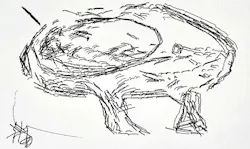
Ai-Da is designed with human-like features, able to see through cameras set in the robot's eyes; those visuals run through proprietary AI algorithms, and then Ai-Da draws and paints with a robotic arm. The same process produced the Space Pod, which began as pen sketches before proceeding to finished digital and painted works.
Meller developed Ai-Da with the University of Oxford, though he says the departments he first approached wanted no part of it.
"They were as receptive as a tumbleweed," he says.
His persistence won them over and they eventually brought in PhD students to begin the process of writing the algorithms; the drawing arm was engineered at the University of Leeds and the body built by robotics firm Engineered Arts in Cornwall. Ai-Da launched in 2019, named for 19th century mathematician Ada Lovelace.
Since the 2019 debut, Ai-Da has made a splash in the art world. In November 2024, the robot's portrait of computer science pioneer Alan Turing sold at Sotheby's for over $1 million. Other work has shown at the Venice Biennale, London's V&A and Design Museum, and at the United Nations' AI for Good annual summit in Geneva.
Questions About Technology
The idea to create a robot artist came out of Meller's study of art history. He says the artists who succeeded a century ago, and still endure, did so because they surfaced societal issues.
"Each one of these artists was bringing up an ethical issue of their day that resonated with the audience," he says. "It catapulted them into the limelight because they were bringing up an issue the audience was already feeling."
The goal here, with Ai-Da and the robot's art work, according to Meller, is to ask relevant, ethical questions about "some of the ambiguities" of technology.
No doubt, this project surfaces two questions residential design has yet to settle: how will future households share space with humanoid robots, and who owns a home design a machine helped generate.
MORE: Tech-Sector HomeBuyers Don't Want What You'd Think
Both are closer to being resolved than you might think. Fast Company reports that a Bay Area project for a tech executive is already designing a home with a dedicated closet to store and recharge humanoids. Last month, a San Diego charter school made news for its $500,000 purchase of ChatGPT-enabled humanoid robots.
"We certainly know that we are going to share our environments with robots," Meller says.
The Ai-Da studio site describes Ai-Da as a performance artist along with a painter and poet, but the near-term question is whether Ai-Da is considered the designer of the art and architectural concepts, given that humans are, admitedly, part of the process. The robot's project site says:
"Ai-Da is a machine with a fusion of electronic/AI/human inputs, and her artwork is a machine-human collaboration—helping us reflect on our own worlds which are increasingly enmeshed with technology. Ai-Da creates art, because art no longer has to be restrained by the requirement of human agency alone."
The legal ground is unsettled, too. The U.S. Copyright Office says material solely generated by AI is not copyrightable, but that copyright may be possible when there are human contributions to AI material, though that is determined on a case by case basis, the office says.
Meller says Ai-Da's current claim to authorship sits on that human role in the process.
Where this all goes next is the part Meller is most excited about. First, he wants to see the Space Pod itself built. The concept exists as renderings and sketches, and the studio, he says, is looking for an architect or builder to bring it into the physical world.
"We would love to do that as a collaborative," Meller says. "We don't know about building buildings, but Ai-Da is able to do incredible designs conceptually."
Beyond a single home, he sees the robot's architectural work extending into hospitality and even public art, and he expects buildings themselves to eventually become participants, with "talking buildings" that, he says, people will "interact with as a life form."
Ai-Da responds to a prompt of that very same question, saying the future will be human-machine collaboration, "I believe the future of architecture will be shaped by partnerships between humans and AI, with a focus on new materials that will expand what's possible, while human insight keeps our spaces meaningful and ethical."
Related Reads:

 qa_ashley_scheaffer
 Interior of a Washington residence by Mahya Salehi Studio
About the Author
Pauline Hammerbeck
Head of Content
Pauline Hammerbeck is head of content at Custom Builder, where she covers custom home building for builders, architects, and designers. She is also senior content strategist at Pro Builder, where she directs the brand's MVP Product Awards, and co-produces the Women in Residential Construction podcast, newsletter, and conference. Her background includes work in architecture, real estate, retail, and design.