Elysian Fields: A Modern Tudor on a Restored Minnesota Prairie
Story at a Glance
- The house is designed with a hidden approach, revealing itself gradually as visitors arrive, emphasizing integration with the landscape.
- A blend of modern and traditional styles is achieved through a thoughtful floor plan that balances shared living spaces and privacy.
- Exterior materials like stucco, natural stone, cedar shingles, and copper details create a textured, warm facade that ages gracefully.
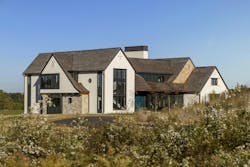
The house doesn't announce itself from the road. Approaching along the winding path that weaves through this design-driven community, a low hill stands between the street and the front door, which to Eric Johnson of the St. Louis Park, Minn.-based Christopher Strom Architects, was an opportunity.
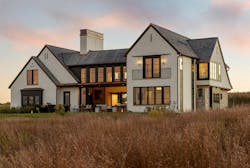
Come around it, he says, and the house unfolds in front of you: a white stucco and cedar-shingled modern Tudor with copper gutters catching light and a teal front door (Benjamin Moore's Tucson Teal for those wondering). Johnson calls it a point of discovery. In this Stillwater, Minn. community, known as White Oaks Savanna, where the landscape and the design vision shape the relationship between the homes and terrain, withholding the view for a time makes perfect sense.
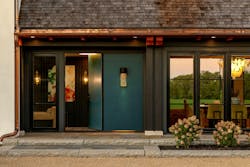
Guests arrive at a front door that is eight feet wide; an adjacent fixed panel makes the entry read twice as large. Step inside, and you'll find it's been painted the same teal as the dining room, with sightlines through a wall of windows out to the prairie beyond. The garage stays out of that arrival moment entirely, Johnson says, tucked away to keep the guest approach clear and special.
Two Visions, Shared Desires
The clients—a couple relocating from a Saint Paul, Minn., loft—came to White Oaks Savanna through the development itself, connecting with co-developer Bob Appert, also co-founder of Redstone Builders in Eagen, Minn., before they had an architect or an interior designer.
Appert connected them with Christopher Strom Architects and Minneapolis-based O'Hara Interiors, and they selected Redstone as the builder. But it quickly became clear the couple had divergent ideas about what their dream home should look like.
"The husband really liked modern, and the wife liked traditional, but they had overlapping reasons why they liked those [styles] and the emotions they evoked," says Johnson. "So the compromise was to start with a floor plan both could agree on and then work toward the aesthetics."
The couple both had Caribbean roots and had spent years in a loft with no room for the extended family visits they'd been missing. They wanted a home that could host relatives for weeks at a time. "You want separation so family has some privacy and space," Johnson says, "but then you come together in the middle and socialize."
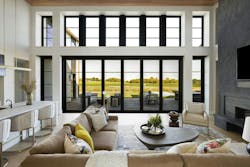
That became the organizing principle: a generous shared great room, along with kitchen and dining, flanked by owner and guest suites on opposite ends of the plan.
Once that was established, the question of style became more manageable.
"When it comes to 'modern vs. traditional,' you can’t solve that right away," says Johnson. "So once that [floor] plan started coming together, they started to realize, you can have these more open modern spaces inside a traditional exterior."
Exterior Jewelry, Texture and Warmth
The exterior cladding became what Johnson describes as the jewelry of the house. Stucco provides a smooth, neutral backdrop for a selection of richer materials: natural stone at the base, cedar shingles, and copper details and gutters that add texture and warmth. A catslide roofline sweeps dramatically on the west elevation (a nod to traditional Tudors), while a flat roof section hidden behind the main roof holds the solar array the clients wanted without disrupting the design.
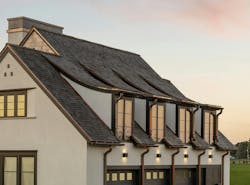
The cedar starts out golden and will mellow toward silver over time, while the copper starts bright and will eventually turn green. Johnson sees that ongoing change as key to the design, a house that changes alongside its landscape.
The copper gutters were a line item that survived, while other materials were swapped out in the interest of budget. The wood ceiling detailing in the great hall, for instance, was originally specified as vertical grain cedar (beautiful, but expensive). Builder Bob Appert brought the team an alternative.
"I had a sample made up of vertical grain cedar and vertical grain Douglas fir and set it out for the group to consider," he says. "Nobody could tell the difference, and the Doug fir came in at half the cost."
North Glass, Cold Glass
Siting the house on the five-acre lot presented its own demands. The best views ran north across the savanna and over 40 acres of permanently undeveloped land, but north-facing glass in Minnesota means cold-facing glass, going against the conventional practice of saving most glazing for the south.
"Growing up in the Caribbean, the indoors and outdoors are blurred," Johnson says of the clients, "but in Minnesota there's a hard separation." The answer was lots of glass and generous openings to maintain those visual connections year-round. "So you don't feel cooped up all the time," he says.
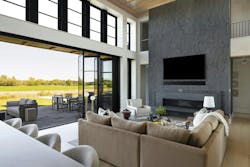
But the 20-foot glazed opening they designed for the north wall became one of the build's most demanding technical achievements. The team worked closely with the window manufacturer to specify glazing suited to that orientation and decided on bifold doors that swing outward.
An outward swinging door, it turns out, has a practical advantage in a cold climate: it tightens against its gaskets when wind pushes on it from outside, producing a tighter seal than an inswing door, ensuring that a generous opening doesn't become a source of leaks through a Minnesota winter.
Appert's team then engineered a spanning steel beam above that wall assembly, to essentially hold it up. But to keep the system functional, the beam could not dip more than a sixteenth of an inch; what Appert says is effectively zero.
"It was a pretty intense detail," he says, which required thickening the entire wall to hide the steel assembly and accommodate shade pockets and the proper depth the system's clerestory windows required.
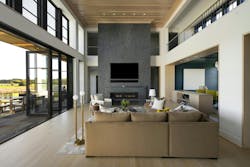
The engineering becomes nearly invisible. In summer, with the doors folded open, the great room and patio read as a single continuous space; in winter, the system stays tightly sealed.
Indoor Personality
Against that crisp backdrop, O'Hara Interiors decided that the home would mark its personality with the interiors.
The great room sets the tone with custom-stained white oak floors, a Venetian plaster fireplace surround with a soapstone mantle, a custom rail catwalk overhead, and that vertical grain Douglas fir substitute on the ceiling that draws the eye up through the full height of the space.
Emily Anderson, a senior designer on the project, describes clients who were unusually willing to take bigger design risks. "They knew from the get-go they were not afraid of color," she says, "and we were to take that and run with it."
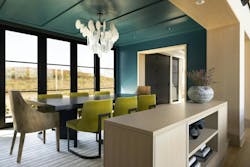
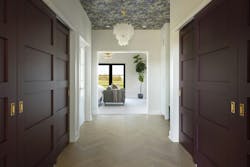
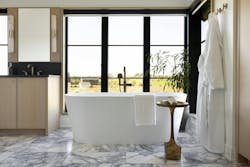
The dining room is paneled in the same deep teal that reappears from the front door. The primary suite closet, which serves as a passage to the bedroom, is treated as its own destination rather than just a corridor, with herringbone flooring, wallpapered ceiling, and doors painted in a deep eggplant purple drawn from the purple veining in the honed marble of the primary bath. It's a room designed so you don't forget you walked through it, Anderson says.
The kitchen was built around the husband's serious cooking habits. With no upper cabinets on the main wall, practical storage required an imaginative solution. After seeing a sliding panel concept on Instagram and recognizing immediately that this client would say yes, O'Hara's team designed a pair of sliding stone panels on either side of the range to conceal a spice rack and a magnetic knife strip.
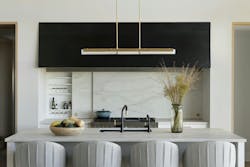
The sliding panel was a complex fabrication, Appert says. The wall was thickened, and hardware had to be carefully specified, because the weight of the panels was a real challenge. Thin porcelain was chosen because natural stone couldn't be milled to the required dimension.
A back pantry adjacent to the main kitchen holds bulk storage and prep space, keeping the showpiece kitchen uncluttered, while giving the serious cook room to work.
Partners With Rapport
Elysian Fields is the third home Christopher Strom Architects and Redstone Builders completed together at White Oaks Savanna, and the first with O'Hara Interiors. The existing relationship between architect and builder smoothed the process with fewer surprises and a baseline of trust, Johnson says. O'Hara's team earned that same confidence quickly. "We continue to work with O'Hara," Johnson says. "We found a great partner."
But collaboration only goes as far as the clients let it. Anderson describes this couple as the ones you could actually take chances with (think of the purple marble, the eggplant-stained closet, the teal dining room). Johnson agrees, saying a project of this scale is a major leap of faith on the part of any client. It's faith in the vision, in the team, and in the early decisions that won't be visible until the house is nearly finished. This couple, he says, stayed true to it all.
Project Details
Location: Stillwater, Minn.
Area: 6700 square feet (5BR/6BA)
Builder: Redstone Builders
Architect: Christopher Strom Architects
Interior Design: O'Hara Interiors
Developer: White Oaks Savannah
Bifold Doors/Windows: Anderson Windows
Kitchen Countertop & Backsplash: Cosentino Dekton Rem
Primary Bath Marble: Artistic Tile's Lilac Marble via Fantasia Showrooms
White Oaks Savanna: A Developer Driven by Architecture
In 2017, builder/developer Bob Appert and his business partner David Washburn stood at a crossroads. They had 320 acres of former Minnesota farmland and a choice to make: take the development down a familiar upper-middle-market path, or brand it as architecturally driven and accept that it would move slower, cost more, and require convincing a market that didn't quite know what that meant.
Appert, who spent 15 years at Pulte Homes including time as VP of Operations, had plenty of experience along the conventional path—land acquisition, entitlement, production at scale—but they chose against it anyway. It took two years to sell the first two lots.
What sustained them was a vision for White Oaks Savanna itself. "We wanted to do it the way we wanted to do it," Appert says, "and not the way market industry standards suggested we should."
Before a century of farming, the site had actually been a white oak savanna, and the development was designed around its restoration. That's why fences are prohibited, manicured lawns are discouraged, and annual burns are held to regenerate native growth.
Drawing inspiration from Sea Ranch, the 1960s coastal California community with a philosophy of "living lightly on the land," homeowners receive five to seven acres each, but the buildable area (house included) is capped at just half an acre, with 40 acres set aside from development entirely, to preserve the long rolling views that define the landscape and the lived experience of each home there.
The development was to be architecturally driven from the outset, so AIA architects-only, with builder approval required for every project. On an open savanna where every elevation is visible and there are no side yards to absorb what you'd rather not show, that decision requires builders and architecst to consider the relationship between each structure and the landscape from the start.
Related Reading
 Designer laying out a sample board of selections for a client
 Tudor home exterior
 Exterior of Seattle Craftsman home
About the Author
Pauline Hammerbeck
Head of Content
Pauline Hammerbeck is head of content at Custom Builder, where she covers custom home building for builders, architects, and designers. She is also senior content strategist at Pro Builder, where she directs the brand's MVP Product Awards, and co-produces the Women in Residential Construction podcast, newsletter, and conference. Her background includes work in architecture, real estate, retail, and design.