The California Lighting Brand That Builds Everything Itself
Story at a Glance
- Founders Bret Englander, Nick Sheridan, and Daniel Wacholder combined their unique skills in journalism, architecture, and engineering to build a lighting company.
- Cerno operates a fully vertical, lean manufacturing facility in Orange County, enabling quality control, customization, and sustainability efforts.
- The company’s three brands—Cerno, Revelite, and Siemon & Salazar—each have distinct identities but share a coastal, natural aesthetic rooted in California modernism.

Welcome to the latest edition of Made to Order, where we profile the artisans and makers behind the innovative products making their way into custom homes.
Bret Englander, Nick Sheridan, and Daniel Wacholder grew up together in Laguna Beach, surfing, exploring local mountains, and taking on projects like building a sailboat or fixing up old RVs.
They went their separate ways after high school, pursuing independent educations and careers. But when they came back together in 2009, ready for a new direction, they had something most business partners spend years developing: a deep understanding of each other’s strengths.
"Daniel studied engineering, Nick studied architecture, I studied journalism," Englander says. "That different and very complementary skill set made it easier because we all knew where we were going to focus our efforts."

Sheridan had been working on high-end California modern builds and was consistently frustrated when it came time to spec lighting. At the same time, LEDs were beginning to disrupt the industry, but almost no one was treating them as decorative.
“I don't know if we appreciated the significance of it,” Englander says, “but our eyes were opened wide enough to see it as an opportunity.”
How Cerno Found its Footing
Tooling out of a small shop in Laguna Canyon, the three developed prototypes under the Cerno banner, including a bedside light that doubled as an ambient sconce or as a task light via an articulating arm. They assembled units until 2:30 a.m. the night before their first trade show and arrived to discover they were the only exhibitors with decorative LED fixtures in the building.
Englander says people were excited to see “new form factors” that could serve as a statement piece while doing the work of LED illumination. Those early wares sold well enough that it settled any questions the three may have had about what comes next.
“We just said we’re going all in, no more consulting in the previous industries we were in,” Englander says. “We’re going to be a lighting company.”

Residential was the first market to take hold, but hospitality followed quickly, and commercial work has recently joined the mix. Englander says the company designs products with residential applications in mind but builds them for durability from the start.
"Hospitality designers appreciate the warmth and natural materials, but know that it is contract grade," he says. "And residential designers get really well-designed, robust products."
Getting there took time. Early on, the partners had to figure out markets and the path to sales. “We were learning about how the lighting industry works,” says Englander. “We had to figure out the rep and distribution model, but once we did, it was off to the races.”
The first seven years went from zero to 60, Englander says, though finding skilled labor is a persistent challenge.
“We make everything here, so that remains one of those challenges,” he says. “But we have a really talented and skilled team of artisans and makers now.”
Three Brands, One Shared California Ethos
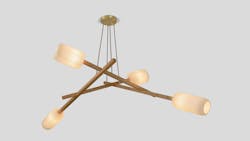
Cerno Group operates under three distinct brands. The flagship Cerno line reflects co-founder Nick Sheridan's architectural training—clean, modern, rooted in natural materials. Revelite is the performance art lighting brand. And Siemon & Salazar, acquired in 2022, produces hand-blown glass pieces; its founders, Caleb and Carmen, remain active as creative directors.
Each brand has its own character, but they all share a coastal ethos. "The juxtaposition of modernism with the natural materials, it has a California modern feel," Englander says. “The nature influence is very strong.”
While the studio doesn’t chase trends, it does listen closely to designer, builder, and architect clients. “That feedback inevitably makes its way into the next generation of products," Englander says. "We want both the quality and the aesthetic to hopefully pass the test of time, and 17 years in, we've had a really good run with both.”
The lineup skews premium, from $500 sconces to $7,000 floor lamps, with Siemon & Salazar chandeliers reaching $18,000. Though the consistent feedback, Englander says, is that the products are fairly priced for American-made quality, and competitive with premium European brands.
The Lean Shift that Changed Everything
It all takes place in a 20,000-square-foot facility in Orange County, where, as a fully vertical operation, raw materials enter and finished fixtures are built, assembled, and shipped out.

A walk through the space moves through a wood shop (one of the more demanding parts of the operation, Englander says, but an early differentiator), over to metal fabrication with laser cutters and routers, powder coating and patina finishing, a machine shop, and a glassblowing studio running at 2,000 degrees. Six engineers—more than 10% of the 45-person staff—handle electrical, mechanical, and custom work.
"A lot of people talk about vertical manufacturing, but [for them] it's not actually all happening in one building," he says.
At Cerno, it is. The company adopted that integrated philosophy in 2016 when co-founder Daniel Wacholder became enamored by the principles of lean manufacturing. The shift from batch production, however, was rocky with some long-time employees pushing back.
The one constraint of the approach, Englander acknowledges, is the limits of current equipment.
“Sometimes your toolbox seems fixed, and you need to add to it to expand capability,” he says. That might mean a new laser, lathe, or 3D printer; for Cerno, adding the glassblowing studio has been the biggest example of that.
"But that's kind of what we've done at every choke point," says Englander. “We find it much more liberating than constraining.”

The lean philosophy has changed how the shop functions and feels. Now, when an order comes in, one person takes a fixture from near-raw material to a finished product and puts their initials on the box before it ships.
"When people have pride and enjoy what they're making, they're going to make it better," Englander says. Shop floor workers are empowered to reconfigure their own workspace and act on improvements without asking permission. "We're creating this culture where improvement is built in," he says, "and it's beautiful to see how that ripples through the entire operation and into the finished goods."
When people have pride and enjoy what they're making, they're going to make it better.
- Bret Englander, co-founder, Cerno Group
That nimbleness proved its value during COVID. Without large inventories on hand, the company absorbed the disruption differently than most. It has also limited the pressures of recent tariffs; Cerno went two years without a price increase, with a modest adjustment coming this spring.
“Our business model does provide resilience,” says Englander. “We’re not completely insulated by any means, but a lot less impacted. We’re more in control.”
Sustainability, in Product and Process
That same thinking extends across the business. The facility runs on a rooftop solar system that offsets the majority of its power. The company pays to recycle materials that many manufacturers might landfill. And there’s a strong emphasis on material yield.
Repairability also factors in. “We really build these things in a way that they can be repaired, hopefully in the field, but if they need to come back here, we’ll fix it and get it back out,” he says. Keeping product out of the landfill, he says, is as much a part of sustainability as solar or recycling.
The vertical operation also has benefits beyond standard production. Custom projects make up roughly 15% of revenue in any given year, and Englander says the team is selective about what it takes on.

"If the challenge excites us, we'll accept it," he says. "That's where we excel, when we're getting challenged and pushed to look at things differently."
Some of Cerno's most recognized products came directly out of those custom commissions, including the Ignis and Imber pendants, which grew from a project with a New York- and Florida-based design studio.
Products across all three brands are built to work within smart home systems—compatible with Legrand and other platforms, including Lutron, which Cerno recently partnered with on what Englander says will be the first decorative integrated LED fixtures to use the company’s Ketra and Lumaris technologies.
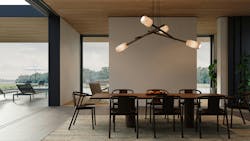
The studio has been exploring cast and sand-cast glass pieces that Englander describes as feeling close to jewelry. Revelite is launching its first battery-operated art light with custom optics designed in-house. And a fixture called the Locus, which combines Cerno's woodworking with Siemon & Salazar’s hand-blown glass, shows what the company can do when the brands operate as one.
When asked what he'd do differently if starting today, Englander doesn't have much of a list. He thinks their early naivete was an asset, because it made them fearless. What kept things moving, he says, was staying close to what made it fun. "When we're all enjoying [the work],” he says, “there's often a surge of really great products that come out of it."
Seventeen years in, they're still at it. And still, he says, having a really good time.
More "Made to Order" Profiles:

QUICK POLL: Have Your Say
About the Author
Pauline Hammerbeck
Head of Content
Pauline Hammerbeck is head of content for Custom Builder, the leading business media brand for custom home builders and their architectural and design partners. She also serves as a senior content strategist for Pro Builder, where she directs the brand's MVP Product Awards. With experience across the built environment—in architecture, real estate, retail, and design—Pauline brings a broad perspective to her work.