Trends Converging to Make Wellness Mainstream in Residential Design
Key Highlights
- The WELL for residential certification pilot has expanded rapidly, and is becoming a full standard in 2026.
- Post-pandemic priorities include indoor air quality, water filtration, soundproofing, and sleep-friendly lighting, reflecting a shift from amenities to health-focused features.
- The challenge moving forward is to normalize wellness features as standard in residential construction, making healthy homes accessible to all.

The residential industry has been talking about wellness for more than a decade, but previous conversations often centered around amenities: saunas, cold-plunge tubs, yoga studios.
Then the pandemic hit. Lockdowns made indoor air quality matter to everyone, and post-pandemic interest in wellness has shifted toward more dedicated interest in home health: water filtration, soundproofing, lighting systems that don't disrupt sleep. These are concepts that would have seemed niche just a few years ago, but they're increasingly taking center stage among client concerns.
Now, the pieces are finally coming together. The International Well Building Institute says its WELL for residential certification program—a framework that measures how homes affect occupant health—has reached nearly 20 million square feet across more than 40,000 units in 22 countries. This month, the IWBI's Governance Council unanimously voted to graduate the program from pilot status. It becomes a full standard in 2026.
More than 3,000 units are already certified or precertified, according to IWBI.
"The pilot program has shown that healthy homes are not just aspirational, but more importantly, they are achievable and scalable," Liz Miles, IWBI's vice president of residential, said at the organization's inaugural Healthy Homes Summit in Los Angeles in September.
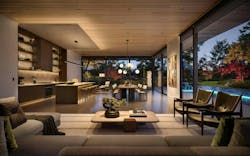
Why Now?
The momentum isn't just pandemic-driven, though that accelerated things. The industry has been building toward this, with research connecting indoor environments to health outcomes, green building standards evolving beyond energy efficiency, and clients asking more sophisticated questions about how their homes affect daily life.
In fact, the wellness real estate market has grown to more than $580 billion globally, according to the Global Wellness Institute.
What changed is that the stars finally aligned: science-backed guidance, growing builder adoption, and increasing client demand are hitting all at the same time.
The WELL for residential standard evaluates homes on a range of concepts, to address growing consumer demand:
- Air and water quality
- Material health
- Safety and privacy
- Healthier eating habits
- Activity and movement
- Lighting and sleep
- In-home accessibility
- Productivity and energy
"As the residential real estate market continues to evolve, homebuyers and renters are calling for homes that prioritize their well-being," Miles said.

Scaling and Staying Affordable
At IWBI's September summit, which drew developers, builders, designers, investors, and housing advocates, the conversation centered on a challenge to make wellness work beyond the obvious luxury projects.
Some production builders are starting small, applying WELL principles to a handful of homes before expanding to entire communities. Representatives from Shea Homes and Johnson Development described making features like adjustable lighting, personalized climate control, and community gathering spaces standard rather than upgrades.
The key, they said, is partnerships and bulk purchasing that add wellness features without pricing out average buyers.
One panel pushed back on the assumption that "healthy homes" require expensive technology. The most effective features, speakers argued, come from smart design decisions made early: lighting systems that match natural day-night cycles, heating and cooling zones that let residents control comfort while saving energy, air-sealing techniques that cut waste by up to 30%.
"Healthy home technologies are most powerful when they're designed in from the start, not bolted on at the end," Whitney Austin Gray, vice president of research at IWBI, said.
Follow the Money
Investors are seemingly paying attention, too. At the summit, representatives from private real estate investment firm DLP Capital and real estate investor/developer Housing Impact Partners described shifting from a focus on traditional returns toward projects that deliver both profit and measurable community benefit: housing that is combined with health programs, nutrition services, and financial education.
As WELL for residential becomes a full standard in 2026, it gives the industry a shared language for health-focused design.
The real test will be in watching whether wellness becomes expected, rather than optional. Will clients prioritize ultra-advanced filtration the way they now expect high-end appliances? Will they pay more for such features, or will they become baseline standards in every project?
For more on the Healthy Homes Summit, see our sister publication Pro Builder's coverage.
You Might Also Like

About the Author
Pauline Hammerbeck
Head of Content
Pauline Hammerbeck is head of content at Custom Builder, where she covers custom home building for builders, architects, and designers. She is also senior content strategist at Pro Builder, where she directs the brand's MVP Product Awards, and co-produces the Women in Residential Construction podcast, newsletter, and conference. Her background includes work in architecture, real estate, retail, and design.