
The Partnership That Made a 'Cabin in a Cabin' Work
Story at a Glance:
- The partnership between Todd Smith and Aaron Lowers is built on early collaboration, mutual respect, and open communication.
- In this 'cabin in a cabin' project, they preserved key elements of a 1915 log home, integrating it into a contemporary shell.
- The architect-builder pair leaned on a long-term working relationship across 16 projects in rural Washington.
Builder in 5 is our five-question Q&A series with the minds behind standout custom homes. In this edition, we're speaking with our first pair: Todd Smith, founding partner of Syndicate Smith (above, left) an architecture and interior design studio in Leavenworth, Wash., and Aaron Lowers, owner of Timberwood Construction (above, right) in Cashmere, Wash.
The two firms have collaborated on 16 projects over the years, across some of Washington’s most challenging rural regions.
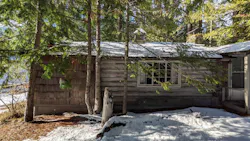
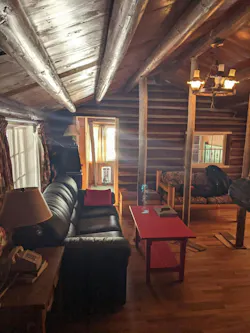
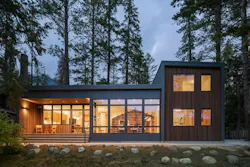
Their latest project centers on a 1915 cabin that was pared back to its essential core and preserved as the heart of a new modern mountain retreat. The log structure remains exposed inside the new build, an older piece carried forward into the contemporary home.
Here, we ask about that unique project and why it's a good reflection of their partnership and approach.
1. How long before this collaborative relationship really kicked in, and what did you learn early on that now feels seamless?
Timberwood (Aaron Lowers, builder): After meeting with the clients for the first time, I knew Todd would be the perfect match for the project.
At this point, we had completed several projects together, and I felt comfortable knowing they would come up with something great.
When Todd first showed me their idea, I remember thinking, "Wow, this is kind of crazy, but let’s go for it." Being involved early in the design made the whole process flow well. I learned early on, working with Todd, that we could bounce ideas back and forth, egos set aside, and focus on the one goal of making something special for our clients.
This creates a seamless working relationship.
Syndicate Smith (Todd Smith, architect): We have had the great fortune to work with Aaron on a number of projects before this. This house, what we call a "cabin in a cabin," was different: a log cabin with lackluster addition(s) that required deconstruction.
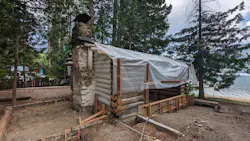
When you get to work with a detail-oriented master like Aaron, and his skill set, the conversation of "hey, we want to preserve the good part of this cabin (the log part) and get rid of the failing parts" is pretty straightforward. It leaps into immediate collaboration to see if [the idea to wrap a new modern home around a 1915 cabin] can work. Because it's so weird, and wants to be solved.
We've learned that once you respect each other ... you [each] know what you know and what you don't know ... it really comes down to figuring out solutions.
The cliche is that the architect and builder have a negative dynamic. This is a choice many choose to follow. But in our case, we love to work together to come up with the best solutions for clients. That's our focus, and so it's a pretty straightforward and seamless collaboration.
2. When a decision doesn’t clearly belong to either of you, what usually determines who steps in and resolves it?
Aaron/Timberwood: Open communication with the client is key. We had regular site meetings to review decisions as a group. It’s our job as the builder and architect to lead the client in the right direction, but ultimately, this is their home. So really, any decision that determined the final outcome was discussed with the client. Being such a unique project, it was fun to have the client interaction throughout the build.
Todd/Syndicate Smith: I think the processes we have in place as a team allow us to assess the correct resolution party rather seamlessly. Best practices of construction management come into play.
Requests for information are generated with the topic in mind, and then directed to the correct party. Structural engineering topics are addressed to the engineer of record. Civil Engineering topics and Mechanical Engineering topics are treated the same.
3. Are there examples of how working closely over time changes what ends up being built in a way that wouldn’t happen if architect and builder were not so attuned to one another?
Aaron/Timberwood: I feel the mutual respect between us leads to a smoother process and, ultimately, a better final product.
Todd knows where he can let us run with certain aspects of the job, and we know when to ask questions. There is never a fear in throwing out ideas or making suggestions. Working with the Syndicate Smith team is a very collaborative effort, knowing everyone has the same focus on doing what is best for the clients.
Todd/Syndicate Smith: There’s a real kinship onsite that comes from our regular site meetings on projects. The freedom to suggest ideas, and pitch thoughts back and forth about the best way to make the owner/client happy within the confines of contractual expectations, is really the goal.
So, with this as our guiding principles, we find that we’re most often on the same page. What results is something more special than when it’s just one of us acting in a silo.
Once you respect each other ... it really comes down to figuring out solutions.
- Todd Smith, Syndicate Smith
4. Are there certain types of projects you tend to take on together? Ones you avoid? What have you learned about where this collaboration works best?
Aaron/Timberwood: We’ve worked with Syndicate Smith on a variety of projects from a small pergola, to remodels, to custom homes. I wouldn’t say there is a certain type of project we would tend to take on together, more so if we are a good fit for the client.
Smaller projects can be just as impactful to a client as large ones, so looking for that good fit is important. But I feel we both like the challenge of the larger, more technical projects.
Both our teams work great together, so it’s fun to see all the interaction throughout the course of a large project.
Todd/Syndicate Smith: We take on projects together where we both know the client is committed to an exceptional end result. We avoid those projects that this knowledge isn’t evident or achievable.
When we can both dive into great projects that value design and craft, this is the collaboration that works best.
5. In this 'cabin in a cabin' project, how did you decide what elements of the original structure were allowed to remain visible once the new house became fully modern around it?
Aaron/Timberwood: After the cobbled together additions were removed, it was clear we were working with something special. The clients wanted to keep it as original as possible so this was our guide.
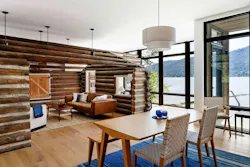
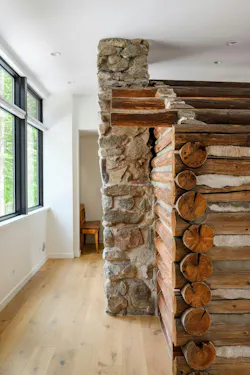
White paint was removed from a portion of the logs and stone fireplace, some chinking was repaired, a little sanding here and there, but overall, it was left as is. Even some moss on the chimney was left which is now on the interior of the house. Part of the roof structure was removed but we were able to repurpose it for the front door and window shutters that hide a TV. After it was done, it was quirky, but worked. The modern shell over the original log cabin worked.
Todd/Syndicate Smith: We all felt it was pretty evident that the additions, built over time, to the original log home were very utilitarian and needs-based as opposed to experience-based. Our aim was to not discount those needs over time but assess what had structural and emotional value.
Ultimately, we felt that those additions were failing. We rewound the historical tape in our minds to think about what was the original dream of this place, and it really felt like this log cabin was the original kernel of “happy” for who originally built it. We wanted to make that element of it shine.
For more insights from the field, read our earlier Builder in 5 interviews, and reach out with suggestions on who we should interview next.
Related Reads:
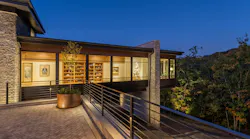 Cantilevered bedroom suite at night
About the Author
Pauline Hammerbeck
Head of Content
Pauline Hammerbeck is head of content at Custom Builder, where she covers custom home building for builders, architects, and designers. She is also senior content strategist at Pro Builder, where she directs the brand's MVP Product Awards, and co-produces the Women in Residential Construction podcast, newsletter, and conference. Her background includes work in architecture, real estate, retail, and design.