A Lighting Consultant on Restraint and the "Wall of Acne" Switches Littering New Homes
Story at a Glance:
- Most lighting issues stem from late decision-making and reliance on inexpensive fixtures that diminish design.
- Effective lighting enhances the home's textures, colors, and architectural features.
- Early collaboration among designers, builders, electricians, and automation specialists is essential for cohesive lighting solutions.
- Quality lighting products offer greater flexibility for adjustments and better long-term support, ensuring durability and performance.
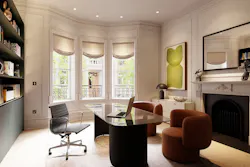
In Part 1 of our conversation with NKBA lighting consultant and educator Kelly Inglis, Inglis made the case that most custom homes are lit like warehouses: where the default is a ceiling grid of lights with $25 wafer fixtures standing in for real design.
Part 2 picks up where that conversation left off: how Inglis structures client conversations, what a $100,000 architectural lighting budget looks like in practice, and why a good control system is what makes all of it usable.
Custom Builder: Where do most breakdowns happen in lighting custom homes?

Kelly Inglis: Lighting decisions get made late. And if a contractor can buy a product at $25—typically what we call flat discs or wafers or slims (they’re all very much the same)—that’s what tends to get used.
By the time these lighting decisions are made, the budget is usually so incapacitated. We’ve spent all our dollars on millwork and beautiful solid surfaces and beautiful floors, but now we’re not lighting them.
CB: So, what happens to all these expensive finishes when lighting doesn’t support them?
Inglis: We have all these beautiful colors and materials and things in our spaces that no longer have the punch or texture or energy that you saw when you purchased them. We put in a beautiful $20,000 solid surface slab on our island, and we have no task lighting on it. We’ve lost the depth and textures and colors that we spent so much money on.
It would be no different than lighting our whole house with a cell phone. These flat discs or wafers are like a flush screen. The optics, the qualities that make it functional, have been removed. Versus what a lighting designer would sell, which actually is something like what we used to have in the '90s, a recessed can in the ceiling.
CB: How do you approach lighting when you sit down with clients?
Inglis: The elements are quite the same in most homes. We sit down, and we talk about high task [areas]. I ask them, ‘Are you cooking?’ ‘Do you have a sewing room?’ ‘Do the kids play board games on the dining room table?’
I often see the dining table and the island lit with one light layer. That’s typically a pretty fixture, but it’s not functional. So now we’re sorting bills, or our eyes age, and it becomes a little bit more difficult to see. And now we’re switching out our light fixture and spending more dollars because it wasn’t thought out in the beginning, even though it looked great.
If we think about it in advance, and put overhead downlighting there that’s functional, that precision hits our work surfaces. We don’t see it, it disappears. But it’s there with purpose.
Then the pretty fixture can be pretty, and the recessed light can be functional. It’s doing all the work.
CB: Where does collaboration across the build team come in?
Inglis: We need everybody included to build the “mold,” so that it works. We all need to be in communication.
When it comes to selections, a designer will take care of all the [decorative lighting]. When those are on and illuminated, we get that cozy option. But when it comes to other functions in our home, architectural lighting needs to be decided in collaboration, otherwise it’s not really cohesive. It isn’t really complementary to the decorative lighting, and it isn't complementary to our lifestyle.
The big home I’m working on now is a very high-end home. It’s not often you reach $100,000 on just architectural lighting. But we are all in conversation. The builder is included. The automation team is included. And the electrician is there [to address technical issues]. We need everybody because we need to understand the installation requirements, and the power consumption issues in the home. We’re dealing with things like coves, and architectural lighting that requires remote drivers [power supplies that often sit away from the fixture], which bring up issues inside a 10,000-square-foot home.
The electrician and control guys need some understanding of what we’re trying to achieve and then the designer and the homeowner can make decisions on what they think is important for the finished results. It’s not one person making decisions in isolation. It’s coordination.
CB: How do you evaluate lighting performance before a home is finished?
Inglis: Lighting designers will create renderings and do lighting calculations so we can actually see the outcome. So, when we're working on a $10 million home, I can actually give a customer a 3D visual.
But “test to verify” is really important when it comes to any unusual lighting design. A local lighting representative is going to have demonstration products that they can take to your site.
I had an experience backlighting stone where we thought warm color would work. We put in different color-tuning light sheets behind the stone. And what we found was, when we moved through the colors, cooler light (which we’d normally never use) brought out all the white veining and made the stone almost look 3D. Warm light just kind of blended it.
And then it’s also important not to make judgments too early, when the space isn’t complete. So, if you’re trying to light in a ceiling of raw wood and raw plank flooring when the job isn’t done yet, and everything isn’t painted, light reflection is going to be different. There are so many other elements that need to be installed before this lighting can actually function at its best. Lighting needs its environment to bounce off in order for it to perform.
CB: What role does product selection play in all of that?
Inglis: If we’re choosing quality products, we have more flexibility to [make adjustments]. Maybe we need a tighter beam spread to light more intensely, or maybe we need to widen it. You have that ability when you’re choosing quality products. You can change the optics and play around and add lenses if they’re too bright or glaring off the glass. With quality products, we have more flexibility to make those adjustments from below the ceiling after [they’re installed]. When we're choosing medium- to low-grade products, that's it.
It’s also important for future proofing. Sticking to reputable brands is very important, because if there’s a failure or issue, they’ll support you. Any brand can warranty a product for five years, but if they’re not here in five years, there’s nothing they can do.
CB: How should lighting function once the home is lived in?
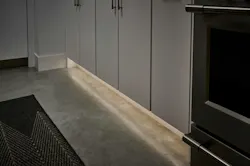
Inglis: We can put in lots of beautiful lights, but if we don’t actually have a control system that works with them, that can be complicated. Because now, with LED, we can add light under the toe kick, we can put it in the cabinets, under the cabinets, overhead lights, pendants, and fixtures.
But we can’t install this "wall of acne” switches. There’s a reason why light switches only come up to four. Our brain can only suffice four, and, still, I end up clicking all of them before I find the one I need.
And then maybe we have evening. So now there’s a little bit of light in the kitchen so I can go in and get a glass of water without having to turn all the downlighting on. But the living room is now slightly more elevated, but lit low below the shoulders, cozy. And now there’s a stream of light down the hallway, really low, so we can safely move about our home.
It’s a more energy efficient [approach]. And it’s better for our mental health because now we’ve eliminated this disruption of light when it’s not required. And it’s just easy to use. It can be one switch. It’s not littering our wall with all of these switches.
CB: What do people have to unlearn about lighting to get it right?
Inglis: We’re not just lighting overhead. We get hyper focused on lighting a reflected ceiling plan and looking down at a grid. The only time we’ll ever see it like that again is if we’re lying on our backs looking at it from the floor.
We need to focus on lighting all the verticals, and lighting below the shoulders. We should have lighting coming in different layers in order for us to feel that space.
The universe is being lit, and then it reflects back at us. And our home should be lit in a similar fashion. We can’t see where it’s coming from, but it’s lit. It’s comfortable. We’re moving about our spaces without having to think.
Kelly Inglis is a lighting consultant with the British Columbia-based Mac's II Agencies and an NKBA CEU-accredited educator. She represents nearly 100 manufacturers across the residential and commercial market and speaks at NKBA chapters throughout North America.