Exterior Lighting is a Design Decision, Not an Add-On
Story at a Glance:
- Exterior lighting demands the same level of control, flexibility, and ease of use as indoor systems, with a focus on creating relaxing and functional outdoor environments.
- Dark-sky guidelines and local ordinances are shaping the industry, requiring shielded, downward-facing fixtures, warmer color temperatures, and timers or motion controls to minimize light pollution.
- Layered lighting approaches—such as ambient washes, task lighting, and accent illumination—help define outdoor 'rooms' and highlight architectural craftsmanship after sunset.
- Early planning and collaboration with lighting professionals are crucial for cost-effective, long-lasting, and regulation-compliant outdoor lighting that enhances property value and enjoyment.
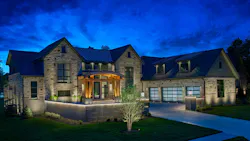
Whether exterior lighting is requested for night swimming, dining al fresco, or to highlight architectural details, trees, or a pathway, homeowners are beginning to expect the same level of control, flexibility, and ease of use from their outdoor systems as they have inside the home.
Meeting that expectation now comes with constraints that didn't apply a decade ago. Dark-sky guildelines call for shielded, downward-facing fixtures and warmer color temperatures to limit glare and light “spill,” and a growing number of local ordinances now require them.
Getting it right also depends on the basics: the right partners, an accurate budget, and lighting design that's integrated early rather than added at the end.
A Second Set of Rooms
When done well, lighting can help create a relaxing environment for homeowners to decompress from the stress of the workday. According to certified outdoor lighting designer Tim Ryan, director of The Lighthouse Group and principal designer of its Lighthouse Design Studio in West Chester, Pa., outdoor lighting can be one of the most valued upgrades for clients, especially those who often only have time to enjoy their properties in the evenings and on weekends.
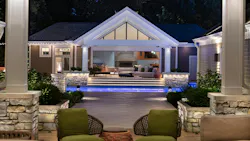
Drew Hohenwarter, AIA, project architect with TONO Group in Lancaster, Pa., says his firm treats exterior spaces as a second set of “rooms” that make people want to linger outside after sundown.
“Dining terraces, pool decks, and outdoor kitchens are being lit in layers: a low, warm wash for ambiance, task lighting over the grill or bar, and accent lighting on a specimen tree to give the eye somewhere to land,” he says.
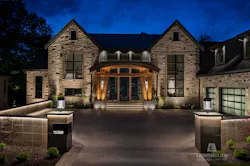
Others note how well-designed lighting can reveal the craftsmanship of a stone façade or heavy timber entrance after sunset.
More: 5 New Products for Outdoor Living
“We’re seeing a move toward lighting that quietly supports the architecture rather than becoming the focal point,” says Erica Volkmer, principal of Evensen Design in Austin. The firm focuses on lighting that integrates into the architecture itself, such as wall washers and concealed fixtures.
Blurring Boundaries
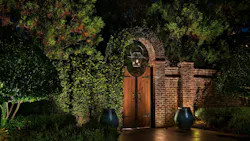
Lighting within the landscape can also be used as a nighttime feature when viewed from indoors. According to Josh Grout, president of Larkspur Builders in San Francisco, the key is to think about sightlines from the rooms where people spend time inside.
Grout sees a trend toward more lighting with less output to make the hardscape recede while highlighting planting beds and tree canopies. “Landscape lighting has become the art direction,” he says.
Avoiding the mirror effect at night is another challenge. “A well-placed up-light on an established tree, a grazing light on a stone wall, or a soft glow along a garden path pulls the eye outward instead of bouncing it back into the room,” says Hohenwarter. “Done well, it blurs the boundary between inside and outside, which makes both spaces feel larger.”
If the interior light levels are brought into balance with the exterior lighting, the reflections on the inside of the glass begin to fall away, says Ryan, leaving a beautifully composed nighttime scene outside the window.
Brightest Doesn’t Equal Best
Builders agree luxury isn’t about having the brightest home on the block, but about creating a sense of warmth, depth, and authenticity.
“In Texas, we’ve seen a strong shift toward a more restrained, dark-sky approach to exterior lighting,” says Volkmer, whose firm prioritizes fixtures that conceal the light source, minimize glare, and direct illumination only where needed.
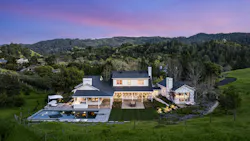
Much of Marin County, Calif., where Larkspur Builders does a good deal of its work, falls under dark-sky rules and codes. “This isn’t a trend for us; it’s the baseline,” says Grout. “At first glance, that sounds limiting, but in practice it tends to produce better results.”
In Pennsylvania, Hohenwarter reports that dark-sky compliant fixtures have gone from a niche concern near national parks to something showing up in mainstream municipal codes, especially in coastal and suburban communities.
He says more jurisdictions are requiring fully shielded, downward-facing fixtures, capping color temperature at 3000K or warmer, and in some cases requiring timers or motion controls so lights aren’t running all night.
“The good news is that dark-sky compliant design usually looks better anyway,” he says.
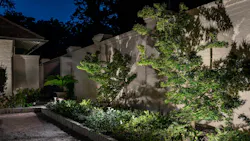
The absence of light can be just as important as the light itself, allowing shadows to reveal texture on facades, shape focal points, add depth, or soften a space.
“Craftsmanship is often revealed through contrast, and lighting is no different,” says Daniel Glick, owner/partner of Paradise, Pa.-based B&D Builders. “Some of the most beautiful parts of a property are the areas left intentionally understated.”
Even as dark-sky principles gain broader acceptance, some designers caution against regulations that treat all exterior lighting the same.
MORE: The Design Details Report: 5 Ideas Worth Stealing
Lighting designer Tim Ryan says there's one caveat regarding dark-sky compliance, in that residential exterior lighting is often grouped together with much larger commercial sources that are actually the primary contributors to sky glow.
“The concern is that some HOAs, municipalities, and review boards are beginning to place restrictions on landscape lighting based on incomplete or inaccurate information,” he says.
Beyond aesthetics and regulations, exterior lighting still needs to serve practical needs, including safety and security.
Security vs. Aesthetics
Security lighting and aesthetic lighting used to pull in opposite directions, but motion sensors, smart controls, and fixtures that offer coverage without reading as security have largely resolved that tension.
Professional landscape lighting often improves security more effectively than ultra-bright floodlights mounted on a house, Ryan says.
“Good lighting keeps contrast ratios lower, which allows our eyes to see more comfortably into darker areas without the pupils constantly constricting from glare,” he says.
Budget Well, Plan Early
Hohenwarter says exterior lighting can run from a few thousand dollars on a modest property to well into the tens of thousands on a larger estate with extensive landscaping, water features, and smart controls. "It all depends on how far an owner wants to take it and the logistics of the specific project," he says.
Who drives that design varies by project, whether it's the landscape designer, the lighting designer, or the architect. "On higher-end work, we're increasingly bringing in a dedicated lighting designer who works alongside the landscape architect," Hohenwarter says.
To avoid rework costs, exterior lighting should be considered as early as possible in the design and construction process, ideally before any conduit goes in the ground.
There’s also the long term to consider. “If the lighting design firm does not offer or provide a long-term preventive maintenance plan, that should be a major red flag,” adds Ryan. “Trees grow, plant material matures, views change, and focal points evolve over time.”
And while it’s just one element of a custom home project, a well-designed exterior lighting plan is one that clients should be able to appreciate every evening—indoors or out—for years to come.
Related Reads:


 The Ember collection from Fontana Forni
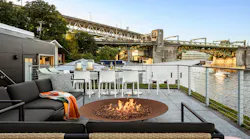 Rooftop deck on a floating home in Seattle
About the Author
 Rita Orrell
Rita Orrell
Rita Catinella Orrell is a journalist specializing in architectural, interior design, and consumer products. She is contributing products editor to Texas Architect and is a former products editor for Architectural Record. She has written for publications including The Architect's Newspaper, Oculus, Metropolis, The Comm Sheet, and Upstate House. Rita lives in Narrowsburg, New York, where she covers local news for Sullivan County Democrat and The River Reporter.