Second-Generation Millwork Shop Scales Up Without Losing Its Craft
At a Glance:
- Axos Designs grew from a Bronx woodworking shop into a nearly 40,000-square-foot operation in Queens and Long Island City.
- The company is adding metal fabrication and plans to bring more related trades in-house to improve scheduling and quality control.
- CNC routers and AI tools support production and estimating, while skilled craftspeople handle finishing and detailed handwork.
- Residential projects now account for about half of Axos’s revenue, including custom millwork for a Water Mill, New York home listed for $23.8 million.
Welcome to the latest edition of Made to Order, where we go behind the scenes with the domestic makers and manufacturers whose work goes into custom homes.
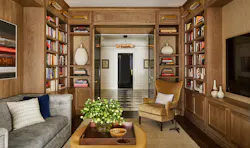
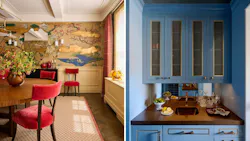
In a private residence on Manhattan's Upper East Side, a library is wrapped in wood paneling and built-in bookshelves under brass picture lights, and a bar is fitted with blue cabinetry and brass mesh uppers. Both came out of Axos Designs, a millwork studio in Queens, N.Y., that produces custom architectural woodwork for high-end restaurants and homes.
That work now extends past wood. Axos is adding metal fabrication this year and already coordinates much of the stone and glass used with its millwork, giving builders and designers a single source for more of the interior work on a project.
Owner Chris Yerolemou says the company works in highly customized architectural work. “We tailor to very high, very custom, very bespoke architectural builds,” he says.
From the Bronx to Queens

Yerolemou's father trained as a woodworker in Cyprus and founded the business shortly after immigrating to the U.S. nearly three decades ago. He opened a shop in the Bronx and later moved to a 10,000-square-foot factory in Queens. “My father knew his trade extremely well,” Yerolemou says, though language and capital limits made the business hard to grow.
Yerolemou left a career in investment banking about seven years ago to help build the company. “There was a gap,” he says. “There was a need, not just in millwork, I think in fabrication in general, for local, bespoke, custom fabrication.”
In January, Axos bought a 30,000-square-foot plant in Long Island City, bringing its total capacity to nearly 40,000 square feet. The company says the plant is the first step in a plan to bring related trades in-house, starting with metal fabrication this year. Axos is outfitting the space with new machinery, vacuum-sealed spray booths, and a showroom.
There was a need, not just in millwork, for local, bespoke, custom fabrication.
- Chris Yerolemou, Axos Designs
At the time, the company reported revenue growth of 55% but Yerolemou says growth brings its own challenges. “Keeping an eye on the old-world craftsmanship without sacrificing it for the rate of growth is sometimes difficult,” he says.
A reputation built in restaurants
Axos made its name in some of New York’s best-known restaurants. The shop built the interiors for Casa Cipriani, a private members club in Lower Manhattan, and Kith Ivy, a West Village members club from the streetwear brand Kith. It also built the shelving and wall paneling in the Aime Leon Dore store, a contemporary fashion brand, and the millwork for the Avra restaurants designed by architecture firm Rockwell Group, including Avra Beverly Hills.
Avra Beverly Hills was the job that lured Yerolemou out of a career in banking. The millwork package was significant, and the restaurant was nearly 3,000 miles from the shop. Yerolemou spent about three months in Los Angeles running the project. “A lot of coordination happens behind the scenes before product event gets there," he says. "And you’re basically six hours away; it's like flying to London.”
That project was a turning point in how Axos gets hired. Yerolemou says architects and designers now often ask for the company by name, citing its quality, speed, and execution, and requesting they handle all the interior work on a project.
Commercial and residential work also generate referrals for one another, he says, with restaurant owners often bringing Axos into their own homes. “They kind of feed each other.”
Hands and machines working together
Axos is adding machines and adding people at the same time. Once the new plant is fully running, the company expects its workforce of artisans, cabinetmakers and installers to nearly double. Yerolemou’s approach is to let equipment handle the repetitive prep so his most skilled people can spend their time on the work clients see and touch.
CNC routers and semi-automated saws handle the cutting, reducing the potential for human error in measuring. Sanding machines do most of the surface prep. “Then we take the last 20% by hand,” Yerolemou says. Staining and spraying stay entirely manual. “All my spraying is still by hand,” he says. Robotic spraying only makes sense for repeat production, he explains, but “we’re not doing 100 chairs of the same size, the same color.”
The new plant will also run AI software for manufacturing, tracking and job analysis. Yerolemou already uses AI to itemize scopes of work and compare drawing sets, which brings an estimate about 80% of the way before an estimator takes over.
"I’m a data person. Always been a data person," he says. "The more data I can get, the more I can make educated decisions to build a leaner and more effective factory."
Many of Axos' craftspeople have been with the company for more than 20 years, and Yerolemou says they have no reason to be concerned about the new equipment. “They’re experts, and they shouldn’t be worried, because part of what we do is the beauty of the handcrafted,” he says. “I still have some very talented builders that will build an entire kitchen.”
The more data I can get, the more I can make educated decisions to build a leaner and more effective factory.
- Chris Yerolemou, Axos Designs
Though he acknowledges that the move to the new plant pushed longtime staff to adopt new tools faster than they might otherwise have. The goal, he says, is to increase speed without losing the standard the shop was built on. “Everything we do is keeping an eye on the original quality and craftsmanship that made us who we are,” he says.
On the shop floor now is an English sycamore kitchen about 15 feet tall, with metal inlays, gouge-carved solid wood and a gold finish under black stain. Yerolemou says it's been some time since he last used English sycamore in a kitchen. And the level of detail goes well beyond standard inset cabinetry. "It’s four levels beyond that."
Expanding beyond wood
As interiors take on more mixed materials, Axos is pursuing what it calls a vertical integration strategy, bringing neighboring trades into its own operation.
The shop often coordinates the stone tops on bars, counters and vanities, since the stone is templated from Axos's own product and drawings. It also prices and installs glass set into its millwork, and wraps fabric panels and handles upholstery in-house.
Metal is the next step. “It's increasingly becoming the larger percentage of projects,” he says, “because there are metal inlays everywhere.” One house Axos is working on now has brass arched doors throughout. “Because I'm building all the wall paneling around it and the framing around it, it makes sense for me to be the coordinator of that,” he says. Bringing metal in-house, he adds, will let the shop “control schedules better, control quality better.”
Axos plans to get there partly through acquisitions, buying specialized fabrication and finishing shops and folding them into its own operation. Yerolemou says owning those trades gives him more control over schedules and quality. For architects, designers and builders, the result would be one company handling more of the wood, metal, stone and glass in a project. That can reduce shipping and the back-and-forth between separate shops, and also shorten lead times and keep finishes consistent across materials.
What clients are asking for:
- More fabric, including what Yerolemou calls "funky fabric," and more metal.
- Cleaner wood profiles that show off strong grain, whether flat or curved, in place of applied molding and Shaker doors. “A nice walnut or a nice zebra or textured oak.”
- More arches and radius corners on cabinets and vanities, “which are not easy to accomplish.”
- Traditional detailing still has a place when a house calls for it, as in the molding Axos built for the Upper East Side dining room.
A house in the Hamptons
Residential work now accounts for half of Axos’s business by revenue and more than half by project count, and Yerolemou says it requires a different level of care. A restaurant loses revenue every week it stays closed, so owners may open when the build is 95% to 98% complete, whereas a homeowner won’t. “They notice every little thing," he says. "Most clients at this level want it to be perfect.”
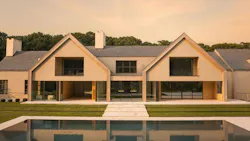
Gable House in Water Mill, N.Y., reflects that standard. The newly built house sits on about 2 acres facing an 80-acre agricultural reserve, with a main house of about 12,000 square feet and a separate potato barn. Daniel Sponzilli of Ravello Builders developed and built it, with architecture by Michael Hill of Studio 3H and interiors by Karen Gorman Design.
Axos served as kitchen design consultant on a kitchen with solid white oak cabinetry and marble countertops, along with a separate prep kitchen and pantry. Yerolemou says the shop also handled the architectural millwork and custom closets throughout the house. It’s now listed for $23.8 million.
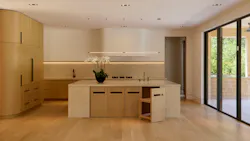
Projects at this scale have changed the business, Yerolemou says. Some of the early large residential projects brought in more work of a similar scale and demonstrated that the company could hanlde it. "It shows proof of concept,” he says. More projects are coming with the same builder, and Axos expects to join the next one earlier in the process. “I’ll get engagement earlier in the project,” he says.
Working with the shop
Axos usually joins a project at design development, when it can price within about 10% on incomplete drawings, Yerolemou says. Once shop drawings are approved and field measurements hold, the shop can build and install a high-end kitchen in six to eight weeks.
Working locally also lets Axos to adjust when site conditions change, something that is more difficult to do with an overseas order once production is approved. “Here, I have clients come touch and feel their product and see it in person before it goes to the finish room,” he says.
His advice to builders, architects and designers centers on keeping design intent through to installation. “The challenge is always taking what an architect or designer's vision is and extrapolating that into the actual field condition, and keeping as much of that intent as humanly possible,” he says. He identifies two critical points that matter most in the process: early in design and just before finishing. “Being very hands-on early, very hands-on before we go into the finish room,” he says. “Those are two critical steps.”
The company is also looking at acquisitions in new East Coast markets this year. Yerolemou says at least one target market is strong enough to support its own factory
As the new plant comes online, Yerolemou says the goal is to maintain the quality that built the shop. “We've been able to progress our offering, progress our quality, and keep the production to match.”
About the Author
Pauline Hammerbeck
Head of Content
Pauline Hammerbeck is head of content at Custom Builder, where she covers custom home building for builders, architects, and designers. She is also senior content strategist at Pro Builder, where she directs the brand's MVP Product Awards, and co-produces the Women in Residential Construction podcast, newsletter, and conference. Her background includes work in architecture, real estate, retail, and design.