Why a New Hampshire Couple Skipped a Renovation and Built a Net-Zero Passive House Instead
Story at a Glance
- The homeowners prioritized sustainability, leading to a custom design that maximized passive solar gain and energy efficiency.
- Site challenges, including slope and orientation, were addressed through detailed analysis that optimized performance.
- The home features a striking cantilevered loft, locally sourced materials, and a low-maintenance landscape that blends aesthetics with functionality.
- Advanced building envelope strategies, including triple-glazed windows and extensive insulation, contributed to achieving Passive House certification.
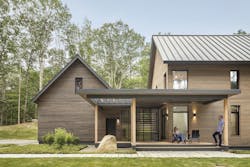
When a nature-loving couple moved to Durham, N.H., they came with a vision of finding a classic New England farmhouse to renovate and make their own.
They rented a barn on a historic property, but the dream didn’t last long. Watching the owner invest excessive time and money trying to modernize the main house convinced them that they ultimately didn’t want to restore an antique.
So, they shifted their focus entirely. Instead of pouring all their resources into an old structure, making compromises along the way, they decided to build from the ground up to get exactly what they wanted: a home that looks like a classic New England farmhouse, but is designed for ultimate sustainability and efficiency through passive building techniques.
Challenges with the slope
The 2.8-acre wooded site the couple found to build on presented a challenge from the start, though. While it had the south-facing exposure they were seeking (passive principles look to maximize solar heat gains to reduce heating costs), the ideal orientation was in a direction that was nearly perpendicular to the site’s slope, requiring additional grading and foundation work.
Phil Kaplan, AIA, LEED AP, principal of the Maine-based Kaplan Thompson Architects, said the extra effort was worthwhile because the clients prioritized achieving net-zero energy and Passive House certification.
“It was our job to make sure nothing else in terms of design was sacrificed in the process of achieving these things,” he says. “We analyzed the energy performance at multiple orientations and determined which one was optimal for both siting, and performance, including the shading of adjacent trees.”
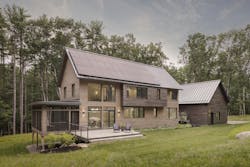
The most favorable solution came through an elongated structure with one end anchored to the hilltop and the other end “walking” down the slope, creating space for a walkout basement beneath an elevated screen porch.
Triple-glazed windows were maximized along that south elevation, while only a few were placed on the north side. All windows in occupied spaces are operable.
Kaplan says having most of your windows on the south side isn't appropriate for all sites.
"If the best view is north, we wouldn't advocate for it,” he says. But, here, the careful placement and balance between the windows to the north and south was essential, not only for energy performance but also for how the space lives and the quality of light.
“Without glass on the north side, there’d be too much glare, and the space would feel uncomfortable,” Kaplan says. “There's no formula that works in all situations, but that’s a benefit of working with an experienced architect with both design skill and technical proficiency."
Form follows farmhouse
The home's final form includes a pitched roof that recalls the farmhouse aesthetic the clients sought. A detached barn-like garage connects to the residence by a covered breezeway, while native plantings pepper the low-maintenance landscape.
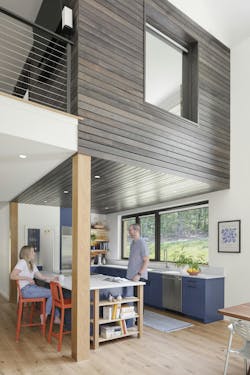
Once inside, the south-facing windows flood the double-height dining and living areas with light and, in the winter, with passive warmth. The 2,921-square-foot home features a mostly open floor plan with three bedrooms and three bathrooms, plus a workout room and offices below.
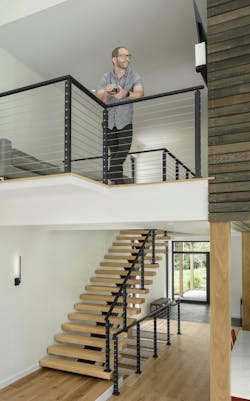
One of the home's most striking features is a cantilevered loft on the second floor that juts out over the main living area, supported only by 2.5-inch laminated structural boards.
The idea came from a planning charrette with the homeowners to find ways to recreate their favorite moments outdoors; this feature evokes the same feeling as peering over a cliff's edge—a sensation accentuated by the nearby window and the view to the outdoors.
"Although not huge, the cantilever was one of the most technically challenging to solve for," says Kaplan. "To put it simply, this was achieved through careful detailing and some pretty dense spreadsheets."
A strong insulation strategy was also key to making the feature energy-efficient, ensuring no heat was lost where the structure juts out.
Beyond the cantilever, the materials here all evoke a sense of place. Sourced locally, the same horizontal pine board cladding used on the exterior was also brought into the interiors, while FSC-certified white oak floors throughout keep the space airy and fresh.
Outside, a boulder harvested from the property and rolled underneath the trellised breezeway pays homage to the old stone wall it formerly anchored nearby.
The building envelope
Efficient mechanicals include three mini-split heat pumps, a heat-pump water heater, and an ERV that exhausts moisture and odors and exchanges them with fresh outdoor air. Extreme attention to taping at every penetration, inside and out, completes the airtight envelope.
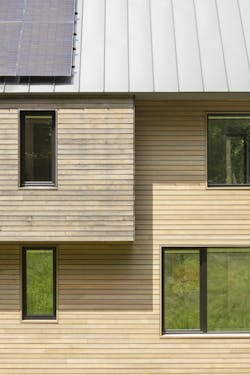
To keep energy use low in the all-electric home, the slab was insulated and the walls were built as two independent stud frames with a 12-inch layer of cellulose insulation between them. The roof carries almost twice that amount of insulation, along with a 12.4-kW photovoltaic array.
The project achieved the Phius Passive House standard the owners sought, earning Phius 2018 Source Zero certification. According to Phius, its designations target the "sweet spot" where aggressive energy and carbon reduction overlap with cost-effectiveness, and they take a full range of variables into account: climate zone, building size, building density, source energy, and costs. Notably, Phius significantly overlaps with other green building standards like Energy Star and LEED.
The bottom line
And while the extra expense of building toward a certified Passive House can be a challenge, in this project, the couple financed their home through conventional loan channels. Now, two years in, they're reporting an encouraging payback.
The home requires 90% less energy to heat and cool than a code-built home of the same size and achieves net-zero energy each year through its solar array. A Home Energy Rating Certificate predicts annual energy savings of $15,744, equivalent to $472,320 over a 30-year mortgage period. That's before accounting for renewable energy input. The owners estimate their actual 30-year savings at $650,000 based on utility statements.
For Kaplan, this Durham, N.H., home offers a roadmap of sorts, pointing out that high-performance construction doesn't mean sacrificing regional character or client goals, which is applicable even if you're not pursuing full certification.
"The principles are all the same," Kaplan says. "Airtight construction, continuous insulation—and lots of it—really good windows and doors. A simple form oriented properly always helps, but understanding building science and having a talented builder who knows how to execute makes all the difference, even in less-than-ideal situations."
For the couple who abandoned their farmhouse dream, the result is better than restoration: a home that looks rooted in New England's past, but performs comfortably and efficiently for the future, saving them hundreds of thousands of dollars in the process.
This home, dubbed Spark Side, was the single-family winner in the 2025 Phius Passive Projects Design Competition, announced at PhiusCon in October.
Project Details:
Location: Durham, NH
Size: 2,921 conditioned sq. ft. (4,370 sq. ft. overall)
Architect: Kaplan Thompson Architects
Builder: Haven Hill Builders
Landscape Design: Soren Deniord Design Studio
Engineering: Trillium Engineering Group
Certification: Phius+ 2018 Source Zero, Energy Star V3.2, Indoor airPLUS
Performance: HERS -10 rating, Net-Zero Energy, 90% less heating/cooling energy than code.
You Might Also Like...

 Meadow House in Alta, Wyo.
About the Author
Pauline Hammerbeck
Head of Content
Pauline Hammerbeck is head of content at Custom Builder, where she covers custom home building for builders, architects, and designers. She is also senior content strategist at Pro Builder, where she directs the brand's MVP Product Awards, and co-produces the Women in Residential Construction podcast, newsletter, and conference. Her background includes work in architecture, real estate, retail, and design.