Design Detail: A Louvered Staircase That Creates a Private Room
Story at a Glance
- This staircase incorporates Japanese-inspired white oak louvers that slide along hidden tracks, creating a flexible privacy screen.
- The project repurposed an existing steel staircase, working through precise 3D modeling to ensure smooth operation and alignment of the components.
- The sliding louvers form a functional wall with a Murphy bed, transforming an open living area into private sleeping quarters.
Welcome to Design Details, where we look at a standout project feature and explore what it took to make it special.
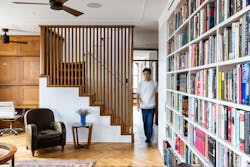
In the center of a New York City penthouse, an enclosed steel staircase has been opened up and reimagined as an adaptable privacy screen.
Using Japanese-inspired operable louvers crafted from white oak, Shuji Suzumori of New York-based practice Suzumori Architecture worked with New York builder Tim Moss of Think Construction to create a feature that transforms an open living area into private sleeping quarters, without traditional walls.
The Louvered Doors in Action:
The feature is part of a larger renovation that sought to maximize the flexibility of a 2,400-square-foot duplex located in a historic building.
Designed and built during COVID lockdowns, the project was able to create a one-bedroom penthouse with the flexibility to occasionally adapt into a four-bedroom home, without compromising on the open, light-filled quality that the clients were seeking in the space.
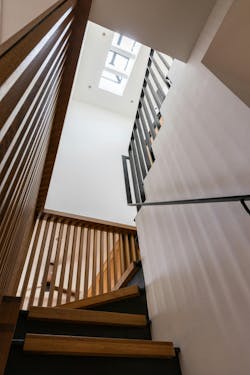
The staircase itself was an existing fully enclosed steel structure at the center of the apartment.
Rather than design around it, Suzumori chose to work with the structure, removing the surrounding walls and guardrails, allowing natural light from the sun-filled library above to funnel down to the living space below.
"In this new environment, the area around the stairs became one of the most desirable spaces in the apartment, a natural location for the living room," he says.
"The idea of adaptability emerged from the desire to occasionally provide privacy and transform the living room into a guest room."
The solution came through two layers of tapered wood louvers that slide along hidden tracks. When the louvers are offset, they form a functional wall, creating a private sleeping area complete with a custom Murphy bed. When aligned, however, the gaps between the two louvers allow light to pass through and help create a visual connection to other areas of the home.
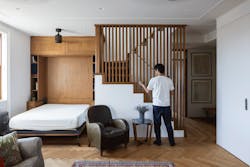
"We wanted this transformable privacy feature to disappear when not in use, as it's only needed occasionally," Suzumori says.
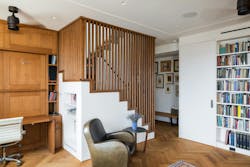
The choice of wood was inspired by traditional Japanese townhouse windows, and Suzumori designed the feature to feel like a piece of furniture. The team explored fabric and glass alternatives, but wood, used in both the new treads and louvers and stained to match the surrounding millwork, offered the most seamless integration, he says.
Translating the concept into a functioning system did present some challenges, though.
“The steel stair structure and surrounding framing were existing, and they were not close to being plumb or level,” says Think Construction’s Tim Moss.
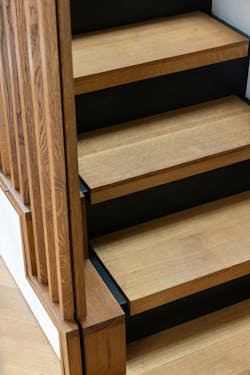
The irregular geometry required precise planning before fabrication could begin. Moss and his team modeled the entire assembly in 3D design software, carefully simulating motion, the overlaps, and the relationships between stair treads and risers. "We had to ensure that no gaps or misalignments would appear," he says.
The most demanding aspect was fabricating the slender vertical wood slats. “Each component had to be engineered with precision to maintain alignment, while minimizing gaps between panels,” Moss says. “This required careful consideration of material stability, so that the narrow wood members would resist warping and avoid binding during movement.”
The hidden tracks allow the louvers to glide smoothly without any visible hardware, maintaining the furniture-like aesthetic the architect envisioned.
"The result is a screen that feels effortless to use but involves complex design and engineering solutions behind the scenes," Moss says.
In dense urban markets, like New York, where space is at a premium, this type of adaptability is a priority for many clients, Moss says. His firm has applied similar thinking to other urban projects, including a 200-square-foot apartment in the West Village, in which an entire bedroom, dining table, and dressing room were made to “magically” pop out of a wall of millwork.
“Achieving these kinds of features requires close collaboration with trusted tradesmen and very high-quality workmanship,” he says, “so that the pieces continue to function smoothly and maintenance-free for many years.”
Project Details:
Architect: Suzumori Architecture
Construction: Think Construction
Oak stairs and louvers: Cabinets by Stanley
Custom Murphy bed: JH Works
Steel handrail: Acid US LLC
Photography: Conor Harrigan
You Might Also Like...
About the Author
Pauline Hammerbeck
Pauline Hammerbeck is the editor of Custom Builder, the leading business media brand for custom builders and their architectural and design partners. She also serves as a senior editor for Pro Builder, where she directs products coverage and the brand's MVP Product Awards. With experience across the built environment - in architecture, real estate, retail, and design - Pauline brings a broad perspective to her work. Reach her at [email protected].