Seattle Builder on His All-In-One Approach to Custom Homes
Story at a Glance:
- Ren Chandler prioritizes transparent communication, detailed budgets, and schedules to prevent project issues and keep clients' satisfied.
- Dyna Builders' in-house metal shop offers custom fabrication to improve craftsmanship across projects.
- Dyna Builders' ability to build floating homes sets them apart in the Seattle market.

Builder in 5 is our five-question series with the minds behind standout custom homes.
In this edition, we speak with Ren Chandler, founder of Seattle-based custom home builder Dyna Builders. The firm brings design services and a metal shop in-house, and is one of the area’s only custom residential firms specializing in floating homes. Custom Builder spoke with Chandler about how these capabilities uniquely position the firm in the Seattle market and how they've come to shape the work Dyna Builders performs today.
1. What’s a decision you made early on in your career that defines how you build today?

Ren Chandler: Early in my career, I made a very intentional decision that our projects would be built around clear communication and detailed budgeting and scheduling. In my experience, most projects that go poorly don’t fail because of the design or the craftsmanship—they fail because of poor communication, usually around budget or schedule expectations.
Because of that, we put a lot of emphasis on transparency from the beginning. We build detailed budgets and schedules, review them regularly with clients and architects, and talk through issues early so there are no surprises. Construction projects are complex and things inevitably come up, but when everyone understands where the project stands and what the options are, problems become manageable instead of stressful.
That philosophy has really shaped how we build today. We focus just as much on managing the process well as we do on executing the physical work.
Most projects don’t fail because of the design or the craftsmanship—they fail because of poor communication.
2. With an in-house metal shop and design services, you offer more than just construction services. How do these capabilities define your approach to new projects?
Chandler: I wouldn’t say those services necessarily define how we approach a new project, but they do give us a lot of flexibility. We’re not strictly a design-build firm, but we do have that capability when a project lends itself to it.
If a client comes to us first, I usually start by assessing the scope and determining whether the project is a good candidate to keep in-house from a design standpoint, or whether it would be better to partner with one of the many exceptional architects and designers we have here in the Seattle area. We’ve built great relationships with a number of firms, and we’re always happy to collaborate when that’s the best path for the project.
Our metal shop, on the other hand, plays a role in most of the projects we take on. Whether we’re working with an outside architect or handling design internally, the shop allows us to fabricate custom decorative metal and small- to mid-sized structural steel elements. It gives us the ability to solve problems quickly, customize details, and bring a level of craftsmanship and efficiency that’s difficult to achieve when everything has to be sourced externally.
Ultimately, it just gives us more tools to deliver the best possible result for each project.

MORE LIKE THIS: 5 Products That Define This Seattle Quincho
3. What’s the biggest challenge you’ve faced on a floating home project? What did you learn from that experience?
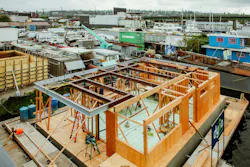
Chandler: One of the biggest challenges we faced came very early in our experience building floating homes. What we learned quickly is that everything takes longer when you’re building on the water.
Floating homes require much tighter tolerances than most people realize, and the integration of wood framing with structural steel adds another layer of complexity. On top of that, because the structure is constantly moving, we can’t rely on traditional tools like levels or lasers in the same way you would on a conventional build. That forces you to approach layout and installation differently and requires a lot of careful coordination.
Everything takes longer when you're building on the water.
That experience taught us to be much more realistic about scheduling floating home projects and to set clear expectations with both our clients and our subcontractors. It also pushed us to refine our processes and become more thoughtful about sequencing and coordination. As a result, we’re much better prepared for the unique challenges that come with building on the water.
MORE LIKE THIS: A Floating Home With Expansive Views
4. Tell us about a project where you took a risk. What’s something others can take away from that experience?
Chandler: One of the biggest risks we took wasn’t tied to a single project, but to the future of our company during the 2008–2009 recession. Work slowed dramatically and we were faced with the same decision many construction companies had to make at the time—whether to lay off a large portion of our staff.
Instead, we decided to keep most of our team intact. Everyone took a modest pay cut and we shifted our focus to smaller projects, often performing more of the work ourselves just to keep things moving. It wasn’t easy, but it allowed us to keep a group of experienced, committed people together.
When the economy recovered, we were ready. We had a seasoned team that knew how to work together and was eager to get back to building larger, more ambitious projects. In the end, the lesson for us was simple: invest in your people and believe in them. Everyone made a small sacrifice during that period, but it ultimately made our company stronger and better prepared for the future.
5. What’s one detail you obsess over that clients might not notice?
Chandler: Lighting is probably the detail I obsess over the most. In my opinion, it’s one of the most important aspects of a house that clients don’t always consciously notice.
When a lighting plan is thoughtfully designed and executed well, it has a huge impact on how a home feels and how the architecture and materials are experienced. Good lighting quietly supports the design—it highlights textures, shapes spaces, and creates the right atmosphere without calling attention to itself.
Most clients won’t necessarily point to the lighting as the defining feature of their home, but they absolutely notice when it’s not done well. Poor lighting can make a beautiful space feel uncomfortable or flat. When it’s done right, everything else in the house just looks better.
Related Reads
 cbbuilderin5
 Seattle floating home
 Exterior of Seattle Craftsman home
About the Author
Catherine Sweeney
Catherine Sweeney is the associate editor for Pro Builder and Custom Builder, where she creates both digital and print content, including Pro Builder’s daily e-newsletter and various news stories for both brands. Before joining Endeavor, she began her career in local journalism, later pivoting to the commercial real estate industry where she worked for several years as a reporter and editor.