The First Ground-Up Rebuild for a Pacific Palisades Resident is an Offsite Home
Story at a Glance:
- This offsite project is the first full rebuild for a Palisades homeowner since the January 2025 wildfires.
- Built using all-steel panels fabricated in a California factory, enabling quick assembly and durability against fires and earthquakes.
- Cover’s vertically integrated process handles permitting, design, fabrication, and installation.
- The project was completed in less than a year, from permit submission to occupancy.
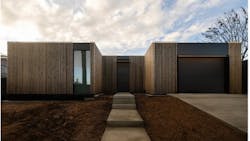
Sue Labella's new home in the Pacific Palisades area of Los Angeles is organized around a central courtyard. Upon entering, there’s a wall of sliding glass overlooking that outdoor space (where a tree is planned for installation soon) and into the living room beyond.
"[The design] brings an abundant amount of natural light right into the center of the home, while creating an outdoor space that's fully private," says Alexis Rivas, co-founder and CEO of Cover, the Los Angeles-based design-build firm that designed and constructed the home.
This is no ordinary new build. The recently completed house is noteworthy as the first ground-up rebuild for a Pacific Palisades resident who lost their home in the January 2025 fires.
The Steel, Offsite Approach
The residence was built in under a year using an all-steel panelized system fabricated in Cover’s 80,000-square-foot factory in nearby Gardena, Calif. The panels are produced on a manufacturing line, then transported to the site for assembly.
“Steel has many benefits both from the production side of things, but also from the quality standpoint. Especially in California where you have wildfires and earthquakes, steel performs incredibly well," says Rivas.
Once fabricated, the panels are transported on standard flatbed trucks and assembled on-site by in-house crews without requiring cranes. Rivas says this is a distinction from some competing offsite systems that rely on heavy equipment for installation.
The same panels can produce homes ranging from 500 square feet to over 4,000 square feet, according to Rivas. "They’re like life-size Lego blocks," he says.
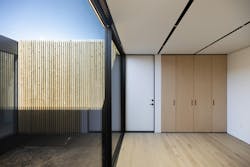
The finished residence for Labella includes the 2,300-square-foot main home and an 800-square-foot accessory dwelling unit, which is also arranged around its own courtyard. Both structures exceed California’s fire, seismic and energy requirements, Rivas says.
LA as Testing Ground
Steel framing accounts for less than half a percent of completed single-family homes, according to the National Association of Home Builders. Still, it’s a material seeing renewed interest in post-wildfire Los Angeles, particularly among offsite construction firms.
Multiple approaches are being deployed: panelized steel system assembled on site, structural insulated panels wrapped around steel frames, and steel extruded from coils directly on job sites. In fire-affected areas facing labor shortages and an urgent need to rebuild at scale, the systems are being positioned as alternatives to conventional wood framing.
Steel framing requires specialized knowledge, and many builders and trades remain more familiar with wood construction. Rivas says Cover addresses this by keeping design, engineering, fabrication, and installation all in-house.
That vertically integrated approach may not appeal to homeowners who want to work with their own architect or general contractor. But for those seeking a single point of contact, that can be the draw.
Labella was a 48-year Palisades resident who lost her home in the fires but was committed to rebuilding in the neighborhood.
“Pacific Palisades has been my home and beloved community for nearly 50 years. My children and my grandchildren grew up in this neighborhood,” she says.
But she was overwhelmed by the prospect of managing it all. On the suggestion of a friend, she toured Cover's factory in Gardena, where the company’s all-in-one approach appealed to her. “I wanted to rebuild without the stress of managing architects, contractors, and permits,” she says.
Working with the Cover team, she designed a floor plan that suited the site and her own needs, and reviewed renderings and material samples before fabrication began. Cover handled permitting.
As a California state-approved factory-built housing manufacturer, Cover's building designs are pre-approved at the state level. Cities just review zoning, setbacks, and foundation plans, according to Rivas.
While panels were being fabricated, the foundation work, utility hookups and other site work were concurrently taking place. Cover then transported the panels to the site for assembly and finish work.
“We don't just sub everything out like a typical general contractor. We have our own crews,” he says. “Because we have those capabilities in-house, you get a lot more predictability. The whole process is much smoother.”.
Permits were submitted in May 2025. Foundations were installed in July. Assembly started in August. The home was completed in December, with a certificate of occupancy issued Jan. 7, 2026, less than a year from permit submission, Rivas said.
Rivas declined to share project costs, though many offsite firms tout the speed advantage as a way to offset a potential premium when construction loan interest and other such costs are factored in.
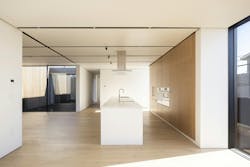
Midcentury Modern Roots
Beyond speed and process, this project reflects a clear design point of view. The firm has a decidedly Midcentury Modern design aesthetic across projects, and Labella’s home is no different.
The home draws from the Southern California tradition of indoor-outdoor living with large expanses of glass adapted for wildfire resilience.
Oversized aluminum-framed windows use double-paned tempered glass. Ignition-resistant, thermally modified wood slats cover the black steel façade. The reflective white roof, designed to help keep the residence cool, carries a Class A fire rating. The structure itself is non-combustible steel and meets urban wildfire requirements.
The detached ADU, with two bedrooms and one bath, is organized around a three-sided courtyard to create a separate private space for visiting family.
Not a One-Off
Rivas says Cover is already building additional fire rebuilds in the Palisades and in Altadena, along with non-fire projects in Pasadena and Redondo Beach. The company has been building in Southern California since 2018.
What distinguishes Cover’s approach, Rivas says, is that the system was designed specifically for factory production rather than replicating standard framing in a warehouse setting. “There’s been a lot of prefab in the past that has just been a typical conventional home,” he says. “But our process is designed for manufacturability from the start.”
The company also offers fully custom floor plans through software intended to streamline engineering and permitting.
“We’ve got this Lego-like system where you can create virtually any kind of floor plan from those Lego blocks,” he says. "We know exactly how we build the homes down to the screw before we even sell it. Our process is designed for manufacturability from the start."
Labella’s home—the first ground-up rebuild completed in Pacific Palisades since the January 2025 wildfires—reflects years of preparation, Rivas says.
"The fact that we're first is more a result of the system that we've developed over more than a decade now," he says.

Project Details
- Location: Pacific Palisades, Los Angeles
- Size: 2,300 sq. ft. main house + 800 sq. ft. ADU
- Builder/Manufacturer: Cover
- Timeline: Permits submitted May 2025; Certificate of Occupancy issued Jan. 7, 2026
- Construction Method: Steel panelized system, factory-built in Gardena, Calif.
- Key Features: Central courtyard; floor-to-ceiling glass; aluminum-framed, dual-tempered windows; Class A roof; detached ADU with private courtyard
You Might Also Like
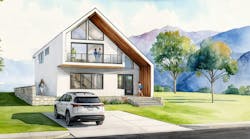 Exterior of the Altadena wildfire-resistant concept home by Essential Habitat Architecture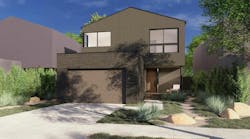

About the Author
Pauline Hammerbeck
Head of Content
Pauline Hammerbeck is head of content at Custom Builder, where she covers custom home building for builders, architects, and designers. She is also senior content strategist at Pro Builder, where she directs the brand's MVP Product Awards, and co-produces the Women in Residential Construction podcast, newsletter, and conference. Her background includes work in architecture, real estate, retail, and design.