Fallingwater at 90: The Restoration of Wright's Most Demanding Home
Key Highlights
- Fallingwater was built between 1934 and 1939 over a waterfall, exemplifying Wright’s integration of architecture and nature.
- A comprehensive conservation project began in 2016, involving 3D scans, moisture testing, and phased repairs to address water intrusion and material decay.
- The project faced delays due to COVID, leading to rebidding and increased costs, but ultimately resulted in a nearly $7.5 million preservation effort.
- Stone walls were stabilized and waterproofing was upgraded with modern, compatible materials to prevent leaks.
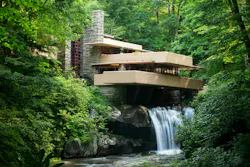
When Pittsburgh department store magnate Edgar Kaufmann, Sr., fell in love with Bear Run, a rugged mountain stream and deep forest valley in Southwestern Pennsylvania, he likely couldn’t have imagined his weekend house would rival its beauty, or become an American icon.
But Frank Lloyd Wright could. The house Wright designed for the Kaufmann family would become Fallingwater, now widely regarded as one of the most important works of American architecture.
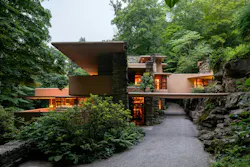
Fallingwater’s Main House and Guest House were commissioned, designed, and built between 1934 and 1939. Wright’s design features reinforced concrete terraces that extend outward like layered stone, paired with long ribbon windows that blur the boundary between interior and landscape.
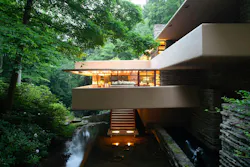
Most striking is the house’s placement directly over the waterfall.
“The family thought they were getting a house that looked at the waterfalls and instead they got a house over top of the falls,” says Justin Gunther, vice president of the Western Pennsylvania Conservancy (WPC), and director of Fallingwater. Wright intended the family not just to view nature, but to live immersed within it.
Whether Wright’s vision outweighed his knowledge of building materials, or the design simply demanded more than the materials could deliver, the result was the same: constant moisture intrusion and structural problems.
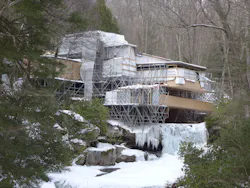
UNESCO World Heritage Inscription
Back in 2016, the WPC, which owns and cares for the property, recognized the need to address those notorious water problems and update building materials that had reached their end of life.
“The whole project started because we were getting prepared for UNESCO World Heritage inscription [in 2019],” says Gunther. “One of the primary commitments you make when you become inscribed is ongoing stewardship.”
The project team undertook an extensive assessment of the building’s condition, during which the team at New York-based Architectural Preservation Studio (APS), which has conducted ongoing preservation work for the property, recommended overlapping manual CAD drawings with photo montages created to document the house in the 1990s.
MORE: The partnership that made a 'cabin in a cabin' work
Over four days in the summer of 2016, while guided tours were ongoing, Douglas Emilio, principal at APS, conducted 3D scans of the exterior. He returned for four additional days in the spring of 2017 to capture the interior, ultimately producing more than 400 scans of the property.
“We sent out the scans to a firm in Paris that converts them to AutoCAD,” says APS president Pamela Jerome. (That firm, Art Graphique & Patrimoine, was also responsible for the AutoCAD conversion of the Cathedral of Notre Dame.)
Another important part of the conditions assessment was a test that revealed how far water was migrating through the walls of the Main House.
“A team from Wiss, Janey, Elstner Associates, Inc. proved that water traveled down the west side of [a] chimney mass, then moved further under two roofing membranes, across [a] room, and wound up two stories down inside [the original owner’s] bedroom,” says Jerome.
Following an exhaustive review, APS and WPC put together a multi-phased project, inviting general contractors to bid on the work.
“Ten bidders were invited. Only one submitted, and it was for $10 million,” says Jerome. (The project budget was initially set at $5.4 million.) So, the team went back to the drawing board and split the project into seven contracts. “We were the GC for the first year,” Jerome says.
MORE: Why Wildfire Zone Homes Are Still Built to a Lower Standard
However, in 2020, COVID threatened to sink the project. “We had started fundraising using the [2019] World Heritage inscription as a catalyst. And then the pandemic happened and we had to shift all our fundraising to operational support just to survive,” says Gunther. “It wasn’t really until the end of 2021 and beginning of 2022, when we were able to restart the fundraising for the project. Of course, by that time, materials had escalated in price. We had to rebid everything and reset our fundraising goals.”
The three-year, nearly $7.5 million World Heritage Preserved project would be Fallingwater’s most comprehensive conservation effort in 25 years, according to Jerome, with the property hiring a preservation project manager in 2023 to act as Clerk of the Works.
Filling and Pointing Stone Walls
In 1938, Wright was quoted in a Museum of Modern Art catalogue dedicated to Fallingwater, the museum’s first exhibition dedicated to a single building, “It is not the deluge of water in a storm that hurts any building: it is ooze and drip of dirty water in thawing and freezing, increased by slight showers.”
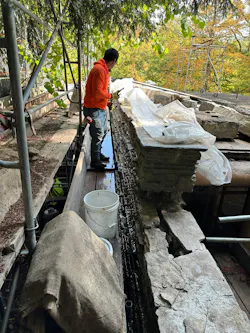
Wright’s remark foreshadowed issues that would trouble the house in the decades to come.
Jerome, who has worked on preservation at the property for more than 25 years, has seen the moisture problem firsthand. “When we finished a major restoration project in 2004, we had cured 59 of 60 leaks,” she says. “By the time we started to do the drawings for the current one, more than half of them had reappeared. Ninety percent of them were related to the stone walls.”
Built from locally quarried Pottsville sandstone, the masonry had been installed in a staggered manner, echoing the uneven stone ledges that project along Bear Run. Protruding stones provide an opportune place for water and melted snow to collect.
“One of the challenges we’ve always had here is the traditional stone masonry,” says Gunther. “Because of the expansion and contraction of the building through changes of the seasons, you get hairline cracks in the mortar joints. Water was always finding its way in.”
Compounding the problem was the absence of through-wall flashing.
Masonry Solutions International, Inc. (MSI) used fiberoptic borescopes and surface-penetrating radar to determine the extent of moisture infiltration. The team found large voids inside the walls, which they remedied with a custom compatible injected fill (CIF) inserted into portholes mostly drilled in from the exterior masonry.
This solution eliminated leaks, improved wall stability (by limiting movement), and expanded and contracted at the same rate as the stone, as well as add heft, acting as a counterweight to the house’s cantilever structure.
When we finished a major restoration project in 2004, we had cured 59 of 60 leaks. By the time we started to do the drawings for the current one, more than half of them had reappeared.
- Pamela Jerome, president, Architectural Preservation Studio
Once completed, the stone walls were repointed. With the walls now solid, water no longer had a route to travel.
To perfect this technique, masonry work was first performed on the Guest House before moving on to the Main House. In total, crews injected nearly 12 tons of CIF (approximately 1,740 gallons) into the hollow walls. The work had its first real test in April 2024, when the area received record rainfall, proving the improvements a success.
Roofing and Terrace Waterproofing
Wright’s low-sloped roof design at Fallingwater reinforced the home’s strong horizontal lines, but it also introduced challenges that roofing systems of the 1930s were not equipped to handle. Even as newer technologies were applied during successive reroofing campaigns, none proved entirely effective.
In June 2024, removal of the Guest House roof revealed a cracked concrete slab and saturated insulation. On the Main House’s third-floor Herb Terrace, a cementitious parge coat installed over earlier cold-tar membrane had delaminated. The existing waterproofing systems had reached the end of their life.
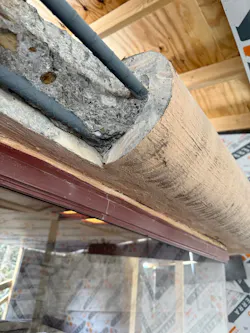
Waterproofing at Fallingwater is especially difficult because of the numerous intersections between roofs and stone walls and the slab’s bullnose detail.
“The rounded roof edges have two issues. One is that there’s no thermal break because the slab just meets the sky,” explains Jerome. “And the second issue was, how do you apply base flashing along a curved surface?”
Siplast and APS devised a plan that used a tinted polymethylmethacrylate (PMMA) flashing to wrap around the underside of the round edges. “We were able to perfectly match the color. This is fussy stuff—very fussy—but we’re talking about one of the most famous houses in the world and a UNESCO World Heritage site,” says Jerome.
The PMMA flashing formed a natural drip edge, preventing water from backing up into the interior. Epoxy served as a vapor barrier over top of which polyiso insulation and cover board were laid.
The final step was a torch-applied modified bitumen roof membrane and pea gravel in a color that matches the original 1930s roof assembly. The team installed a mock-up of the roofing system on the Guest House’s “monitor,” a raised roof with clerestory windows over the building’s bathroom, before being installed throughout the rest of the project.
“All the products have to be compatible,” says Jerome. “The way you figure these things out is you do mock-ups and then you let them sit there for a year.”
On Fallingwater’s terraces, flagstones were numbered and removed; crews demolished the old waterproofing and replaced it with a liquid flashing and cold-applied membrane system. Then the stones were reinstalled by Fallingwater’s maintenance team in their original location.
Concrete Repairs
Wright’s design for Fallingwater pushed reinforced concrete to its limits, and the concrete mix itself introduced additional complications. Within its first 20 years, the Kaufmanns were already performing concrete repairs.
“The problem with the concrete is twofold,” says Jerome. “Wright used rounded river pebbles, causing a lack of bond with the cement paste. We also have ASR (Alkali-Silica Reaction) that causes constant cracking. A lot of areas were recast as a result because it’s essentially dead concrete; there’s nothing sound to patch to.”
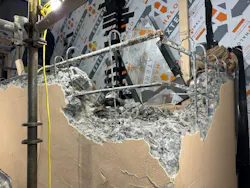
The original installation methods also proved problematic. Like the rolled edges of the roofs, the rounded caps of parapets were added after the walls cured, creating a cold joint that resulted in cracking over time.
As part of the World Heritage Preserved project, Matteo Ferran Structural Engineers assessed the condition of parapets and determined where demolition was necessary. Specialists from Graciano Corp. performed concrete reconstruction wherever necessary, pouring concrete into plywood molds and hand applying a parge coat to replicate the original finish.
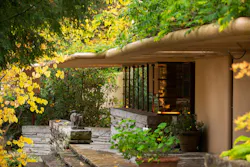
The canopied walkway connecting the Main House to the Guest House also required repair where deterioration had exposed the steel-reinforcing bars. New concrete was applied, along with a fiber-reinforced cement matrix, to bolster the canopy structure.
Window and Door Conservation
The exterior conservation work wasn’t exclusive to walls, roofs, and concrete; the project also demanded careful attention to Fallingwater’s windows and doors, where Wright’s design ambitions introduced a different set of conservation issues.
On the window tower, most visibly, Wright ran glass directly into vertical channels in the stonework rather than into a steel frame, creating an uninterrupted continuity of materials, as well as sealant challenges.
“The glass panels were basically mortared into the stone walls. Mortar contracts at a different rate than glass. It just doesn’t work. The glass was cracking,” says Jerome. “These joints were big – like two or three inches in some places; too big for sealant and also too big for a mortar joint. We ended up creating straight mortar joints so that we could put silicone in and get a tight seal that’s not going to leak and will affix the glass without breaking it.”
Fallingwater’s steel frames, a departure for Wright, who had mostly relied on the traditional wood sash until the late 1920s, were no match for the site’s persistent moisture, leading to oxidation and rust over time.
MORE: Design Detail: A Daring Cantilevered Bedroom Suite
As part of the World Heritage Preserved project, crews applied an industrial steel coating to protect the steel frames and extend their performance (tinted to match Wright’s chosen “Cherokee” red color).
All doors received new laminate glass in 2025 and 2026; windows were reglazed wherever cracking and other failures required it.
The aging of building materials over time at Fallingwater doesn’t diminish Frank Lloyd Wright’s genius. Now 90 years old, the house remains one of his most demanding and most studied designs and continues as a fascination for the AEC community and a destination for the public alike. It’s the reason the house, now a public museum, welcomes as many as 145,000 visitors each year.
This article origionally appeared in Architectural Products, an Endeavor Business Media publication. It is republished here with permission, and has been lightly edited for length.
Related Reads
 Exterior of the completed Owensby home, one of the first restoration projects Scroggs Construction Services untertook in the aftermath of Hurricane Helene.
 Great room interior of a Toll Brothers home
About the Author
Jana Madsen
Jana Madsen is an experienced communications and marketing professional with more than 20 years of expertise in writing, editing, and content strategy developed through reporting on and working within the AEC industry.
Through her work with D. C. Taylor Co., freelance clients such as Architectural Products magazine, and previous editorial leadership with BUILDINGS magazine, she's developed a strong ability to collaborate with subject-matter experts, manage creative projects, and translate complex ideas into clear, engaging, and accessible content.
Her work is grounded in a clearly defined editorial process that includes research collection, source interviews, transcript review, organization of supporting materials, and careful content development. She is committed to communicating clearly, accurately, and with integrity, always striving to present the full story in a way that resonates with both technical experts and laypersons. Known for meeting word counts and deadlines while maintaining exceptionally high standards, she relentlessly pursues details that elevate the quality, clarity, and credibility of the final piece.